


As per a market.us report, generative AI will touch $255.8 billion by 2033.(Market US, 2024)
A Financial Times survey of Fortune 500 companies put the number of organizations that have adopted gen AI at a whopping 92 percent. (Financial Times, 2024)
While predictions in AI are largely speculative, there are certain trends in existing data that guide market decisions. Let us explore them!
You’ll find the stats organized across five major sections. Let’s look at some more detailed stats today.
On this page
Generative AI Market Size and Growth
You can see statistics along with their more intuitive graphs to see how the market for gen AI is expected to grow:
1. The generative AI market value was only $29 billion in 2022 and has grown to approximately $50 billion today – a 54.7% market growth from 2022 to 2024. (Statista, 2024)
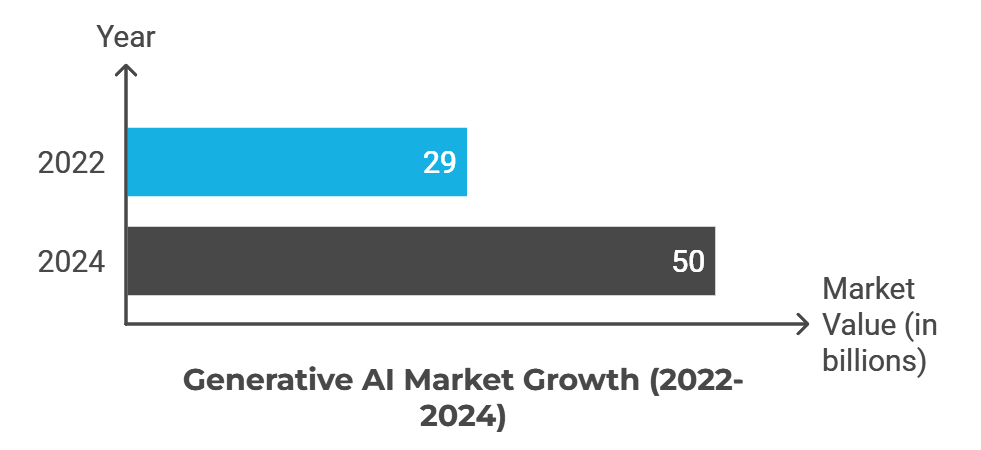
2. The global generative AI market is expected to reach $88.35 billion by 2025. (Statista, 2024)
3. Generative AI could become a$1.3 trillionmarket by 2032. (Bloomberg Intelligence, 2024)
As we can see this is a very promising sector.
This explosive growth rate shows us a hint of how, in the future, investors and companies will have to grapple with exponential growth and volatility.
4. The training market will likely grow faster than inference in the near term and could reach $470 billion by 2032. (Bloomberg Intelligence, 2024)
This implies that good-quality datasets and compute required for training will be in high demand.
5. Hyperscale suppliers, including Meta, Microsoft, Alphabet, Nvidia, and Amazon, will likely be among the main facilitators for training LLMs. (Bloomberg Intelligence, 2024)
Let us see how this affects the broader software industry:
6. Generative AI could expand to 10-12% of total information-technology hardware, software, services, advertising, and gaming expenditures by 2032. (Bloomberg Intelligence, 2024)
Even though you see a 10x increase, Gen AI only makes up about 10% of software spending in this projected graph.
Generative AI Adoption and Trends
As you have seen, Fortune 500 companies adopt generative AI.
Fortune 500 companies represent two-thirds of the U.S. GDP with $43 trillion in market value, so this does put competitors who don’t use AI at a possible disadvantage.
How has this technology been adopted already? Let’s find out:
1. 70% of Gen Z have tried generative AI tools. (Salesforce, 2023)
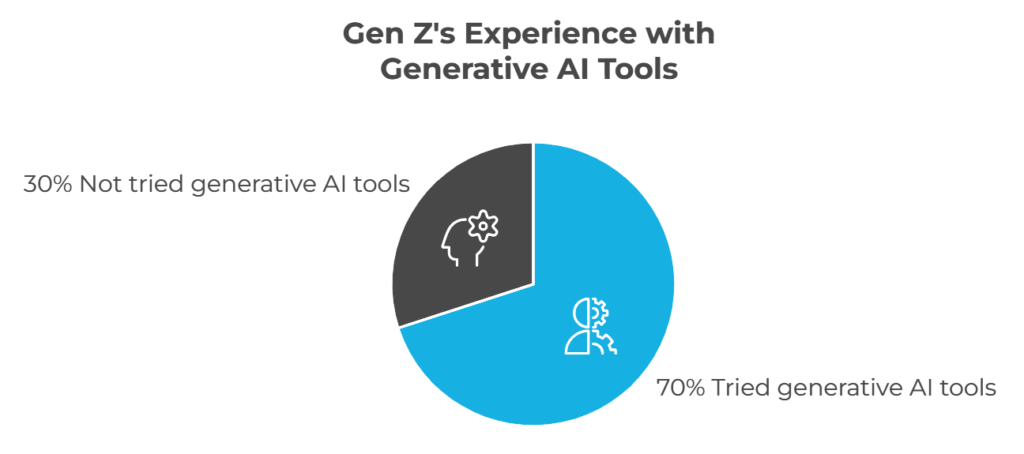
The new generation is rapidly adopting tools such as ChatGPT. Fast learning and adaptability appear to be a valuable skill set for the current workplace.
This technology is still in its early phases of being adopted.
A lot of organizations do expect this adoption to revolutionize the industry though.
2. Over 85% of organizations surveyed identify increased adoption of new and frontier technologies and broadening digital access as the trends most likely to drive transformation in their organization. (World Economic Forum, 2023)
3. 73% of marketing departments use generative AI. (Statista, 2023)
Automation of jobs is also one of the central concerns.
4. Generative AI could expose 300 million full-time jobs to automation. (Goldman Sachs, 2023). This represents around 10% of the total global workforce.
Here we can see how the levels of advancements in AI affect labor displacement as well as the productivity of the existing workforce.
5. Computer vision and conversational AI products will emerge as new categories for inferencing, given the availability of large-language models for domain-specific predictions. (Bloomberg Intelligence, 2024)
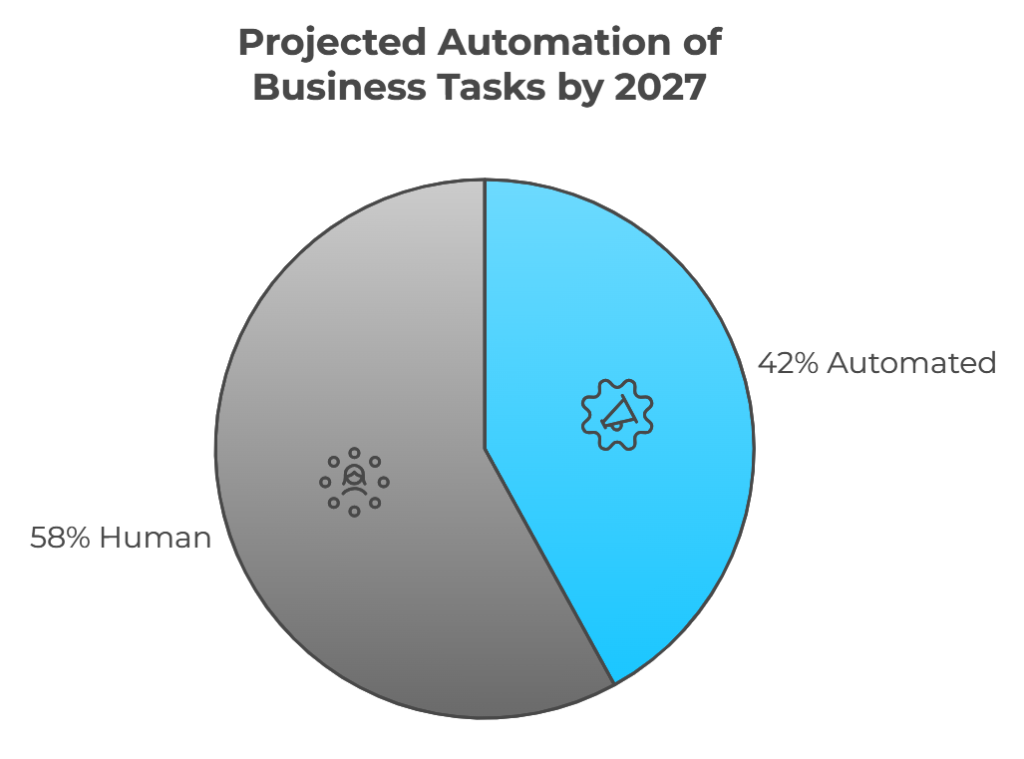
6. Today, respondents have revised their expectations for future automation to predict that 42% of business tasks will be automated by 2027. (World Economic Forum, 2023)
Trends in Conversational AI
Chatbots are an AI application gaining a lot of interest recently, let’s see what the companies surveyed are saying!
7. If the alternative were to wait 15 minutes for an answer, 62% of consumers would rather talk to achatbot than a human agent. (Tidio, 2024)
Quick availability and a reduction in wait times seem to be major influences on service jobs becoming automated.
We see that bigger industries see potential in Generative AI technologies like chatbots significantly more than smaller ones.
The context of the issue of the customer influences the demand for AI chatbots versus a human agent.
8. AI could generate up to 97 million jobs by 2025. (World Economic Forum, 2023)
While people are aware that AI will automate many processes, it also presents novel opportunities for job aspirants.
9. “There is a misconception about how easy it is to run mature, enterprise-ready, generative AI,” said Stela Solar, Inaugural Director at Australia’s National Artificial Intelligence Centre, in the survey report. (Microsoft, 2024)
The exposure risk to white-collar jobs seems to primarily be towards the repetitive and procedural factions of work.
10. 45% of organizations are piloting generative AI programs in sectors such as the healthcare sector, IT, robotics, banking, and finance. (Gartner, 2023)
Leading Generative AI Companies
The generative AI landscape is dominated by a few key players who have established themselves as leaders in different segments of the market.
Let us look at some of the key players in this field:
1. NVIDIA leads the data center GPU segment with a 92% market share. NVIDIA utilizes generative adversarial networks to enhance creativity and revolutionize industries such as art, entertainment, and content creation. (IoT Analytics, 2023)
2. OpenAI and Microsoft have a combined share of 69% in the foundational models and platforms market. Foundation models are key to generative AI because they can adapt to a lot of tasks by fine-tuning the model instead of completing retraining. (IoT Analytics, 2023)
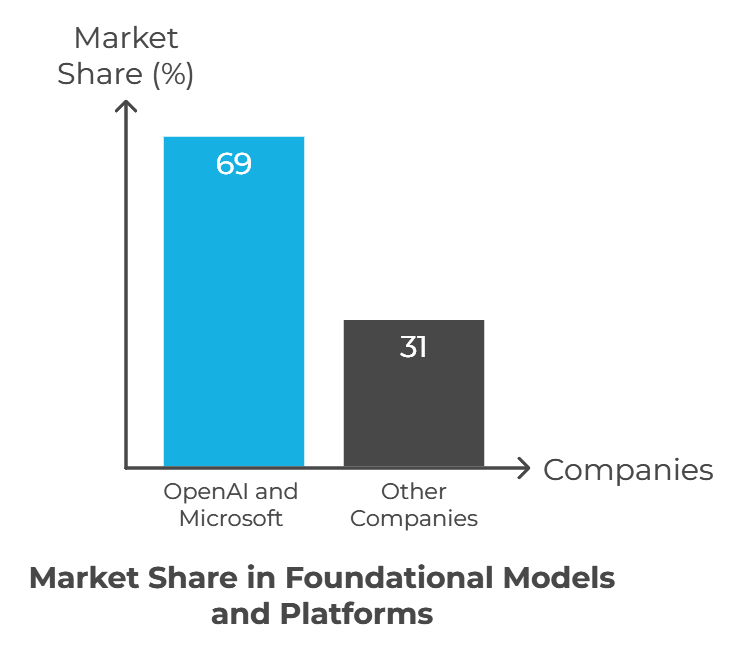
It is clear that when it comes to GPU, NVIDIA is the nonpareil dominant player. The report shows the data center GPU market reached $49 billion in 2023.
3. Accenture currently leads the generative AI services market with a 6% market share. Leading AI companies and startups are developing and using generative AI solutions. (IoT Analytics, 2023)
Generative AI Usage by Marketers and Salespeople
Marketers, known for their early adoption of new technologies, are at the forefront of generative AI implementation.
Sales professionals, while somewhat slower to adopt generative AI compared to their marketing counterparts, are beginning to recognize its potential.
Let us look at how generative AI is transforming the marketing and sales sectors:
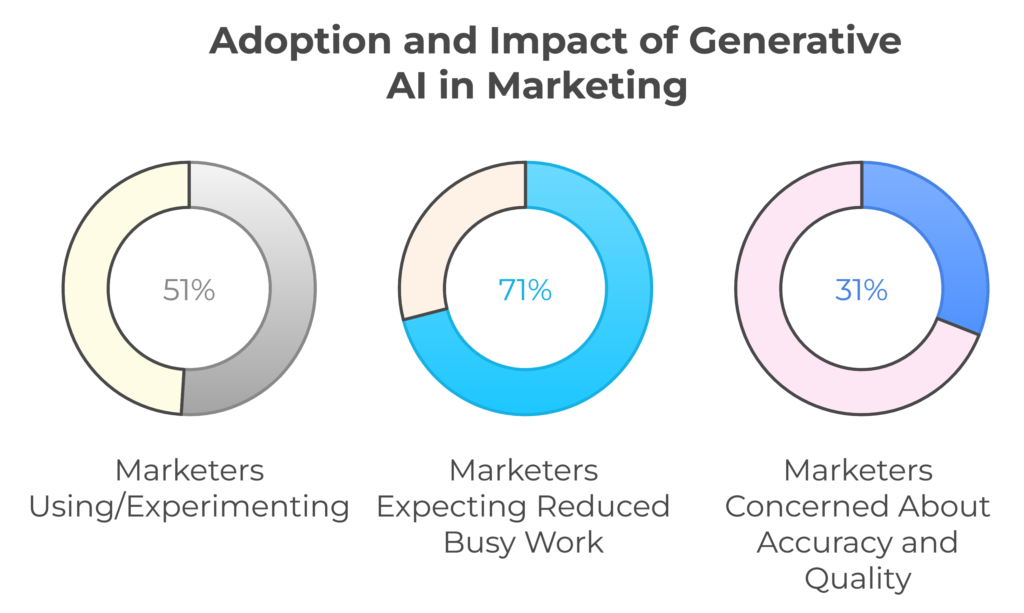
1. 51% of marketers are already using or experimenting with generative AI. Generative AI software is expected to play a key role in various industries, such as fashion and entertainment. (Salesforce, 2023)
2. 71% of marketers expect generative AI will help eliminate busy work and allow them to focus more on strategic work. (Salesforce, 2023)
3. 31% of marketers ranked accuracy and quality as their top concern with generative AI. (Salesforce, 2023)
Generative AI can produce convincing and seemingly professional content that could be completely inaccurate.
4. Only about one-third of salespeople said they used or planned to use generative AI, compared to 51% of marketers in a survey of around 1000 people. (Salesforce, 2023)
Yet, in a different survey of a similar scale:
5. 61% of sales professionals said they believe generative AI will help them better serve their customers and sell more efficiently.
6. 84% of salespeople currently using generative AI said it helped increase sales at their organization. (Salesforce, 2023)
How do marketers use generative AI?
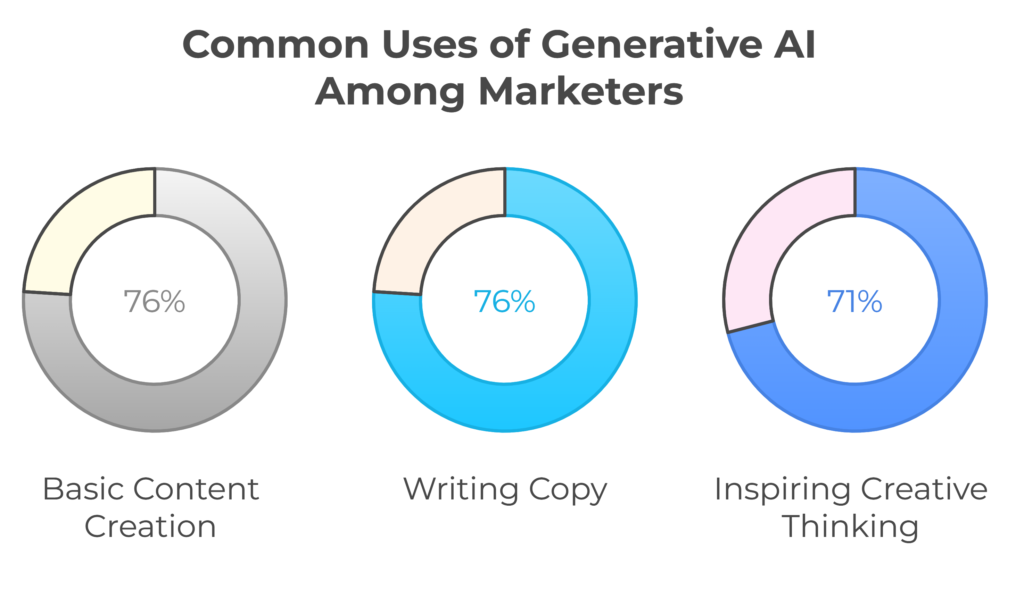
7. The most common uses of generative artificial intelligence among marketers are basic content creation (76%), writing copy (76%), and inspiring creative thinking (71%). (Salesforce, 2023)
Final Thoughts
The market for Generative AI is undergoing a steep rise in the coming years, with key players such as NVIDIA and Microsoft in focus. It is already being widely adopted in the field, and it impacts several industries, spanning from content creation to sales and marketing.
For a broader perspective on how it will affect the creation and automation of jobs, you can visit the The Future of Jobs 2023 report by the World Economic Forum.

About the author
Editorial Staff
The Editorial Staff at Bot Memo is a team of writers, analysts, and AI agents dedicated to mapping the global AI startup ecosystem. Led by Chintan Zalani, the team tracks thousands of funding rounds, classifies companies across verticals, and distills it all into actionable intelligence for investors and founders.