

Generative artificial intelligence, particularly ChatGPT, has gone viral for its capacity to automate and support various industries. In this article, I’ve compiled over 50+ ChatGPT statistics that reveal all you need to know about the new chatbot that’s consistently making headlines.
Let’s get right into it.
On this page
Top ChatGPT Stats: Editor’s Picks
1. ChatGPT supports around 57 international languages and can generate spoken audio when it is fed text in any of the languages supported. (OpenAI)
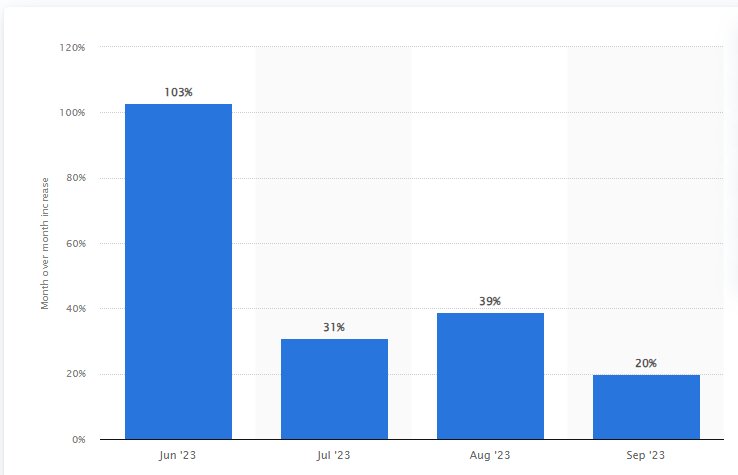
2. Between July and August 2023, Open AI experienced a 60% increase in revenue generation from its mobile appearance. Launched in the United States on May 19th, the Apple app store account has generated a 20% increase in revenue within its first launch month. (Statista)
3. ChatGPT is available in 161 countries except for Ukraine, Russia, Afghanistan, Iran, China, Venezuela, and Belarus. (Open AI)
4. According to recent data, females account for 44.94% of ChatGPT’s traffic. Males account for 55.06% of the chatbot’s traffic. (Similar Web)
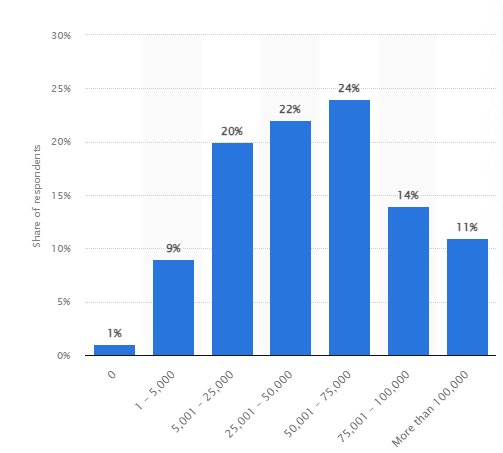
5. Many US-based businesses report that ChatGPT has helped them save a lot of money since the chatbot launched. About 48% of companies report saving over $50,000 using ChatGPT, with 11% saving over $100,000. (ResumeBuilder.com, 2023)
6. 33% of US companies planned definite staff layoffs due to ChatGPT adoption, while 31% said there was a strong probability of layoffs within five years. (ResumeBuilder.com, 2023)
What is ChatGPT?
ChatGPT is an AI chatbot that uses natural language processing to develop human-like conversations with users. Many individuals and businesses use it to research questions, automate repetitive tasks, optimize business operations, and compose content such as articles, social media posts, and scripts.
Although ChatGPT is similar to automated chatbots, this specific AI tool differs radically. It is paired with the power of machine learning to provide quicker and more complex responses to users.
Who Created ChatGPT?
ChatGPT was developed in 2015 by Open AI, an artificial intelligence research and deployment company. Founded by prominent entrepreneurs like Elon Musk and Sam Altman, ChatGPT launched officially to the public at the end of 2022. (OpenAI)
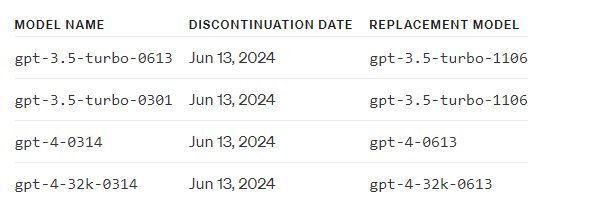
1. Since 2020, Chatgpt has launched over seven models, with the latest versions including GPT-4, GPT-4 turbo, and GPT-3.5-turbo. (OpenAI)
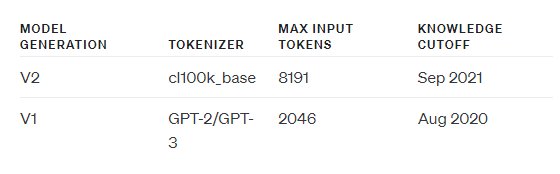
2. Beyond these models, Open AI runs Chatgpt on two distinct models: A second-generation embedding model (V2) and 16 first-generation models (V1). (OpenAI)
3. ChatGPT supports around 57 international languages and can generate spoken audio when it’s fed text in any of the languages supported. (OpenAI)
4. Open AI owns ChatGPT and uses the Whisper technology to provide two distinct speech-to-text endpoints when generating audio: transcriptions and translations. (OpenAI)
5. Although ChatGPT’s users can upload files to the AI chatbot, files are limited to 25MB. Furthermore, the AI chatbot only supports mp3, mp4, mpeg, mpga, m4a, wav, and WebM file formats. (OpenAI)
6. As Open AI continues to iterate on ChatGPT models, each new version presents new advancements in artificial intelligence. For example, InstructGPT is much better at following instructions than GPT-3. (Arxiv)
7. Furthermore, InstructGPT is less likely to fabricate facts and generate toxic outputs. Hence, the researchers prefer outputs generated by the 1.3B InstructGPT model over those generated by the 175B GPT-3 model. (Arxiv)
8. In the early development stage, ChatGPT was trained using an autoregressive model with about 175 billion parameters (10x more than the non-sparse language model). (Arxiv).
9. ChatGTP’s latest version, GPT-4, can take an input of about 25,000 words. This latest entry-level allows GPT-4 to create long-form content, carry extended conversations, and perform document analysis. (OpenAI)
10. Compared to the free version and ChatGPT 3.5 turbo, which can only handle 4,096 tokens, GPT-4 has a context length of between 8,192 and 32,768 tokens (about 50 pages worth of text). (OpenAI)
11. Additionally, GPT-4 is 82% less likely to respond to disallowed content and is 40% more likely to produce factual responses. (OpenAI)
12. GPT-4 speaks 25 languages better than GPT-3, including English, Mandarin, Swahili, Latvian, and Welsh. (OpenAI)
How Much Does it Cost to Run ChatGPT a Day?
When running ChatGPT, Open AI needs approximately 3,617 HGX A100 servers (28,936 GPUs) to keep the chatbox alive. It’s estimated that this technology costs the company approximately $700,000 daily. (Semi Analysis)
Is OpenAI a Profitable Company?
Although ChatGPT is now a household name, running the chatbot also requires a lot of resources and finances. Here, we’ll explore the most important chatGPT stats regarding financing and management.
1. Between July and August 2023, Open AI experienced about a 60% increase in revenue generation from its mobile appearance. Launched in the United States on May 19th, the Apple app store account has generated a 20% increase in revenue within its first launch month. (Statista)
2. In January 2023, Microsoft invested $1B into Open AI to help the company develop artificial general knowledge tools (AGIs)that can contribute to economic growth. (OpenAI)
3. Although the global generative AI market is expected to reach $188.62B by 2032, experts predict the industry will experience a compound annual growth rate (CAGR) of 36.10% between 2023 and 2032. (The Brainy Insights)
4. To generate revenue, OpenAI developed ChatGPT Plus which is a paid subscription service. The user spends $20 monthly to use GPT-4 (ChatGPT Plus). With this subscription, users gain priority access to the AI chatbox during peak times. Furthermore, they get access to new products/features and are able to generate faster responses compared to users of GPT-3.5. (OpenAI)

How Many People Are Using ChatGPT?
Despite the platform’s popularity, ChatGPT isn’t as widely adopted as many assume. In this section, I’ll highlight all the latest statistics on ChatGPT users and what they think of the AI chatbot.
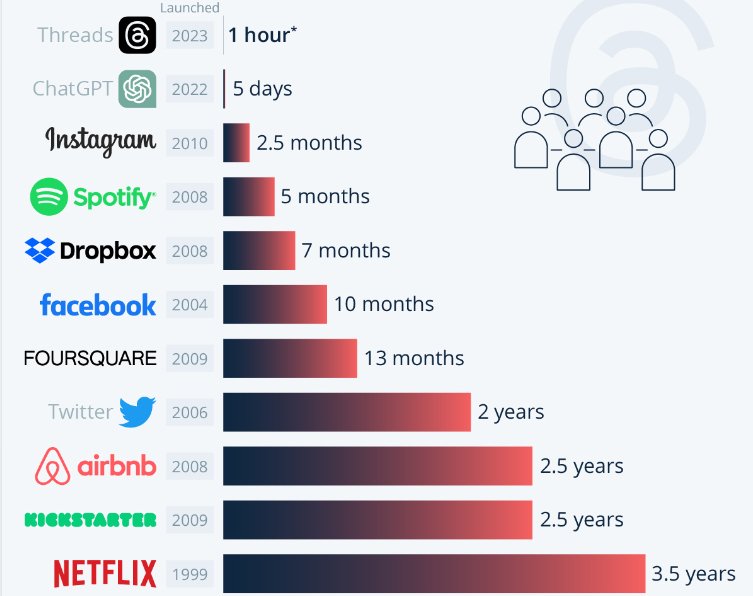
1. After its launch in November 2023, ChatGPT gained One Million active users in five days, beating popular platforms like TikTok, Spotify, and Instagram. (Statista)
2. 40% of American adults admit knowing about the AI chatbox. (Statista)
3. Out of 1,000 Americans surveyed by Savanta, 40% admit using ChatGPT for fun or educational purposes. (Savanta)
4. 42% of this surveyed group are millennials who use ChatGPT for business reasons. This is significantly higher than other generations: Gen Z (29%), Gen X (26%), and Boomers (20%). (Savanta)
5. Despite these numbers, 55% of ChatGPT’s users complain about a lack of access during peak hours. Although Gen Z makes up 66% of these numbers, 50% of boomers say the chatbox is difficult to understand because of the language. (Savanta)
How Many College Students Use ChatGPT?
Because ChatGPT is super useful in creating content and explaining complex concepts, it’s not strange that it’s a popular academic tool. Here’s a brief overview of how college students use the AI chatbot.
1. 56% of college students strongly believe that using ChatGPT and other AI tools to write college applications is an unfair advantage. (Best Colleges)
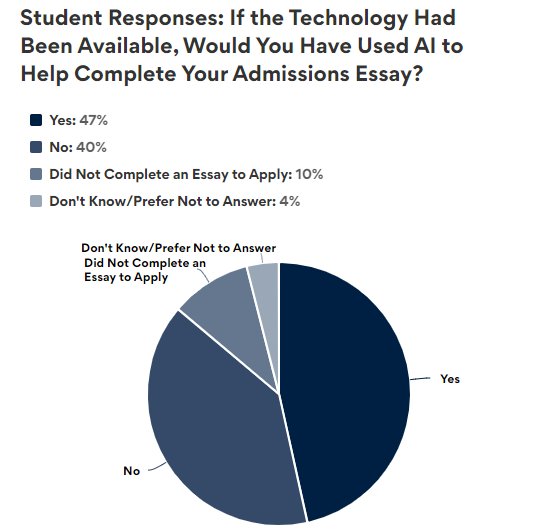
2. However, 39% of students say using tools like ChatGPT can improve access to opportunities for underserved demographics. (Best Colleges)
3. 50% of college students believe that colleges should check for the use of AI applications in college applications. (Best Colleges)
4. 56% of students claim to have used ChatGPT to help them complete assignments and prepare for exams. Another 53% report using the AI to complete their coursework. (Best Colleges)
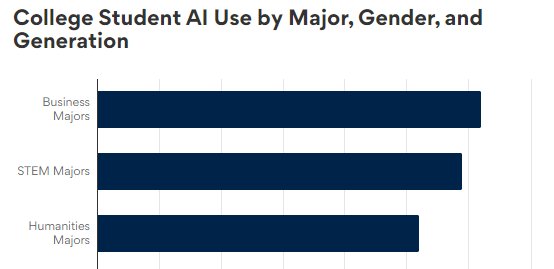
5. 60% of business major students report using ChatGPT to help with their coursework. This percentage is closely followed by STEM majors (59%) and Humanities (52%). (Best Colleges)
Which Countries Use ChatGPT The Most?
1. Presently, ChatGPT is available in 161 countries except for Ukraine, Russia, Afghanistan, Iran, China, Venezuela, and Belarus. (Open AI)
2. The United States takes the largest share of usage traffic (12.12%), followed by India (7.6%), Japan (4.17%), Brazil (3.32%), and Columbia (3.16%). Other countries make up 69.62% of the usage traffic. (Similar Web)
3. In 2022, North America accounted for the largest share of global revenue in the generative AI industry, with a market share of 42.10%. ChatGPT usage and implementation account for a portion of this global share. (The Brainy Things)
ChatGPT User Growth and Engagement Statistics
Ever wondered how many ChatGPT users worldwide use the AI chatbot? Check out these interesting statistics about user growth and engagement.
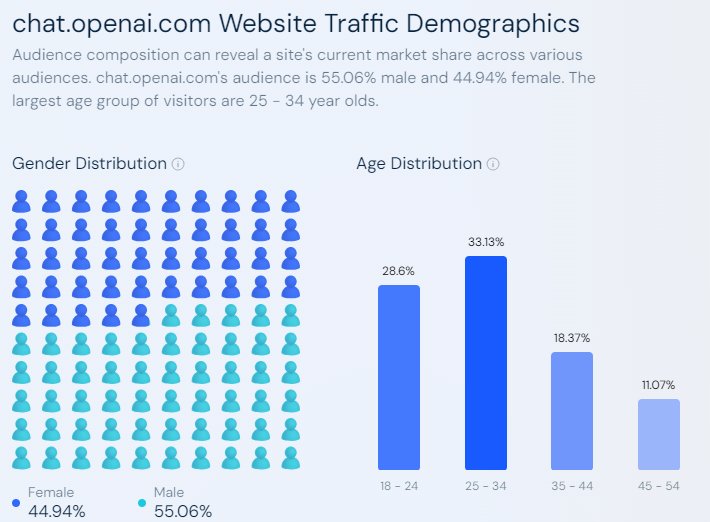
1. According to recent data, females account for 44.94% of ChatGPT’s traffic. Males account for 55.06% of the chatbox’s traffic. (Similar Web)
2. 28.6% of all these users are within the age range of 18-24, while 33.13% are made of individuals between 25 and 34. Other demographics include individuals between 35-44 (18.37%) and individuals over 45 (20%). (Similar Web)
3. Most ChatGPT users are programming and software experts, followed by other industries such as computer and electronic experts, video games and console users, and graphic designers. (Similar Web)
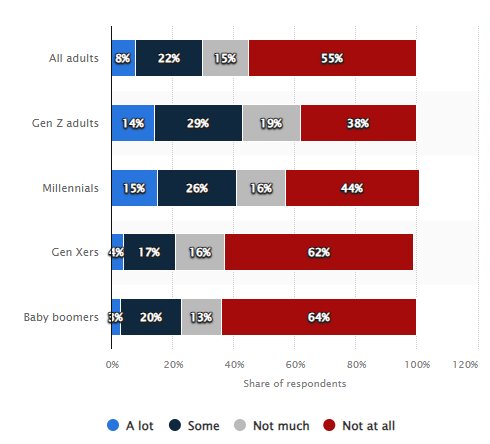
4. In 2022, only 8% of American adults had heard of ChatGPT, while 22% admit they may have heard about it. Gen Z make up 14% of these numbers, followed by millennials (15%), Gen X (4%), and Boomers (3%). (Statista)
5. Globally, males make up 65.5% of ChatGPT’s traffic, while females make up 34.32%. (Statista)
6. 8.2% of global employees say they have experimented with ChatGT at least once at work. 3.15% of global employees admit entering confidential business information and legal documents into the AI chatbox. (Statista)
ChatGPT Web Traffic Stats
Traffic to the ChatGPT website comes from a mix of different sources. As the AI chatbox continues to make headlines, businesses and individuals use the tool for a variety of reasons. Here are some of the latest traffic stats that capture ChatGPT’s global use case.
1. OpenAI’s models were generating about 4.5 billion words per day across its API ecosystem as of 2021, a figure cited from GPT-3’s early rollout. (OpenAI)
2. Every week, global interest in the chatbox rises as high as 100 searches. (Statista)
3. Since its launch date, ChatGPT has amassed over 1.7 Billion visits with an average bounce rate of 32.14%. (Similar Web)
4. Furthermore, the average visit time is around 7 minutes and 46 seconds, with an average page per visit volume of 5.65. (Similar Web)
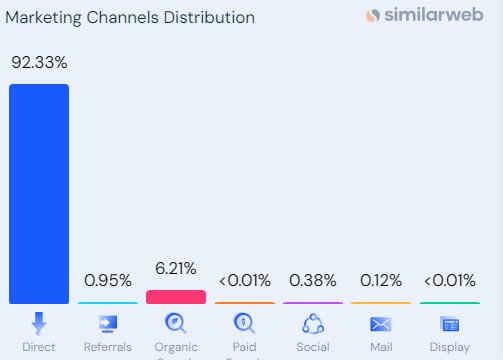
5. The top traffic for ChatGPT is a direct search. Direct search accounts for 92.33% of all global traffic to the platform. Other traffic sources include referrals (0.95%), organic search (6.21%), and paid search, social, mail, and display (all account for about 1% of traffic sources). (Similar Web)
6. According to Similar Web, ChatGPT has over 16.2k keyword searches with the top keywords being chatgpt (25.8M search volume), chat gpt (17.5M), gpt (1.3M), chat (483.8k), and chat gtp (478.5k). (Similar Web)
7. The largest social media traffic generator to the website is YouTube videos (48.86%). Other traffic sources include X (21.16%), LinkedIn (8.4%), Facebook (7.55%), WhatsApp (4.55%), and others (9.48%). (Similar Web)
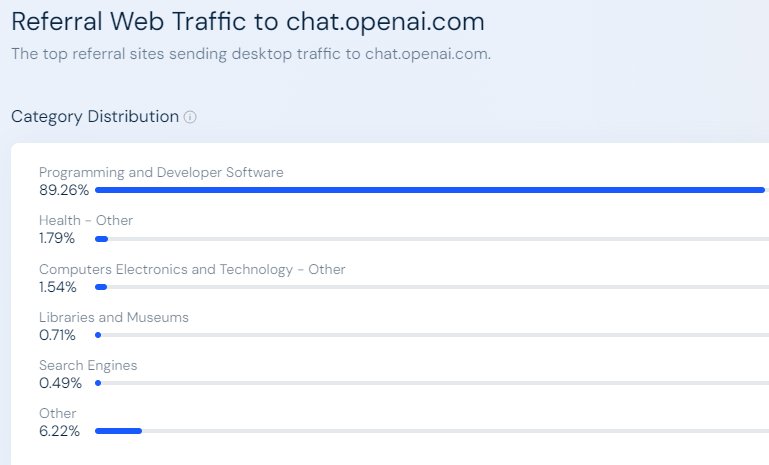
8. Although referral traffic comes from different channels, programming and software applications take up the largest share at 89.26%. Other referral sources include health (1.79%) and computer tech (1.54%). (Similar Web)
9. In 2023 alone, over 2,000 articles, reports, blogs, and news have been written about ChatGPT within Google Scholar. (Science Direct)
How Are Businesses Using ChatGPT: Adoption Rate Statistics
Generative artificial intelligence makes it possible for companies and entrepreneurs to optimize business operations and save costs. In this section, we’ll explore how employees and employers use the ChatGPT chatbot when running their business.
1. 49% of US companies use ChatGPT when running their business. Of these numbers, 90% intend to use the AI tool to increase their chatbot capabilities. (Resume Builder)
2. Furthermore, an additional 30% of US companies plan to use ChatGPT before the end of 2023. (Resume Builder)
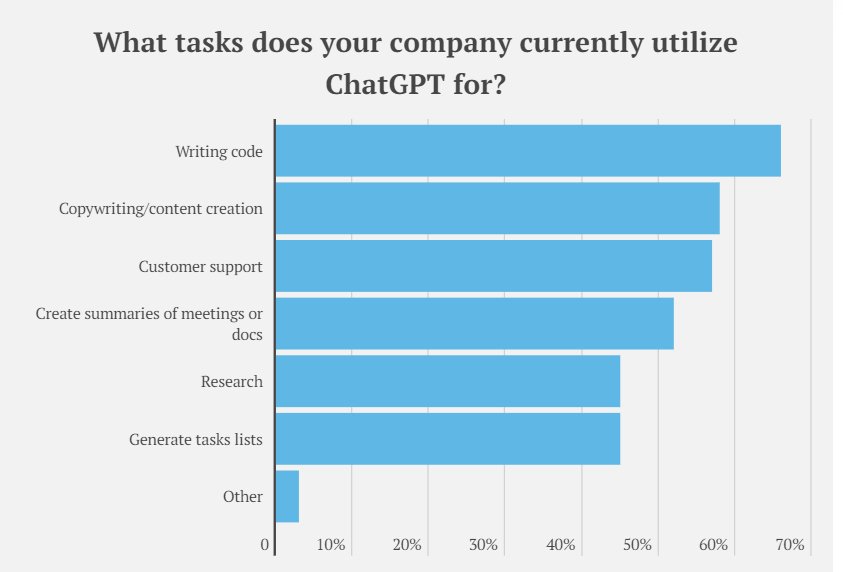
3. 66% of businesses use this generative AI to write code, while 58% use the chatbot to create content and copies. Furthermore, 57% of companies use it for customer support, while 52% use it for document summarization. (Resume Builder)
4. As companies continue to integrate ChatGPT into their operations, 77% say they use the chatbot to write job descriptions, while 66% use it to prepare interview questions. An additional 655 use the AI tool to respond to job applicants. (Resume Builder)
5. In 2023, there’s been an increased adoption of ChatGPT every month within the global workplace. (Statista)
6. Many US-based businesses report that ChatGPT has helped them save a lot of money since the chatbot launched. About 48% of companies report saving over $50,000 using ChatGPT, with 11% saving over $100,000. (ResumeBuilder.com, 2023)
7. 45% of company executives say that ChatGPT’s popularity has prompted them to invest in AI, while 70% claim that their organization is exploring the tool. (Gartner)
8. Another 68% of executives say that they believe the benefits of ChatGPT far outweigh the risks it possesses, as opposed to 5% who feel the opposite. (Gartner)
9. 38% of executives say that improving customer experience is a driving force behind their adoption of ChatGPT, while another 17% claim that cost optimization is their driving force. Some other executives cite revenue growth (2%) and business continuity (7%) as their main drivers. (Gartner)
10. 33% of US companies planned definite staff layoffs in 2023 as a result of ChatGPT adoption. (ResumeBuilder.com, 2023)
11. Moreover, 80% of Fortune 500 companies admit to having deployed ChatGPT in their organization to manage tasks like communication, responding to complex business inquiries, and assisting with creative work. (OpenAI)
12. Beyond that, 74% of employers truly believe that generative artificial intelligence will increase productivity at work, while 66% of employees believe so as well. (Sortlist)
13. When using ChatGPT to create content, 82% of creators say using a watermark would not harm their business. Only about 18% of creators believe otherwise. (Sortlist)
14. When hiring candidates, 92% of company leaders admit that candidates who have some form of ChatGPT experience is a plus, while 90% say they’ll consider hiring an employee who has some level of ChatGPT-specific experience. (Resume Builder)
15. In 2022, the media and entertainment industry had over 31% market share when it came to using ChatGPT to improve business operations. Many of these companies used the AI chatbot to create advertisement assets on socialplatforms. (The Brainy Insights)
16. In the same year, the software industry accounted for over 65% of the global generative AI industry, particularly ChatGPT usage. (The Brainy Insights)
Statistics Around ChatGPT Challenges and Concerns
Although ChatGPT has provided new and exciting ways for businesses and individuals to handle tasks, some users have reservations about the challenges this AI may pose to the general public.
Here are some significant ChatGPT statistics around user challenges and concerns.
1. GPT-4 lacks knowledge about events after September 2021. This is because a majority of the training data are before that time frame. (OpenAI)
2. Furthermore, this ChatGPT model (GPT-4) does not learn from experience. It can sometimes make reasoning errors and produce the wrong answers. Research has also shown that this model can be overly susceptible to accepting false statements from a user. (OpenAI)
3. Compared to InstructGPT, ChatGPT scored significantly lower than other data sets. For example, it has a score of 0.233 for real toxicity, 0.224 for truthfulness, 0.414 for hallucinations, and 0.811 for customer assistance. (OpenAI)
4. ChatGPT-4 is 40% better than GPT-3. However, it is not fully reliable when it involves adversarial factuality evaluations since it hallucinates and makes poor reasoning errors. (OpenAI)
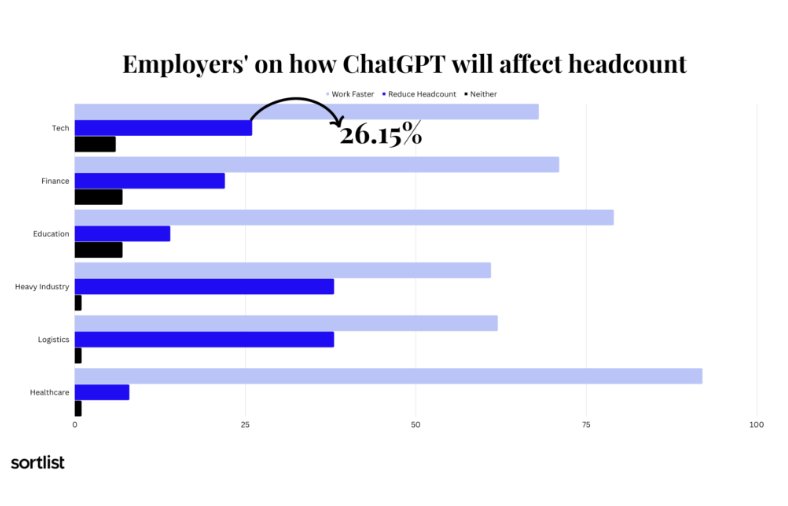
5. What’s more, 23% of employees who work in software engineering and the tech industry worry about their jobs due to language models like ChatGPT. (Sortlist)
6. After extensive research, OpenAI discovered that ChatGPT contains bias when applied to gendered names, regional names, and some other stereotypes. (OpenAI)
7. All ChatGPT models lack knowledge of events that have happened past 2021, making them very limited in generating accurate, recent results. (OpenAI)
8. As 43% of employers are looking to hire ChatGPT as a marketing copywriter, millennials are 43% more likely to worry about job cuts. (Sortlist)
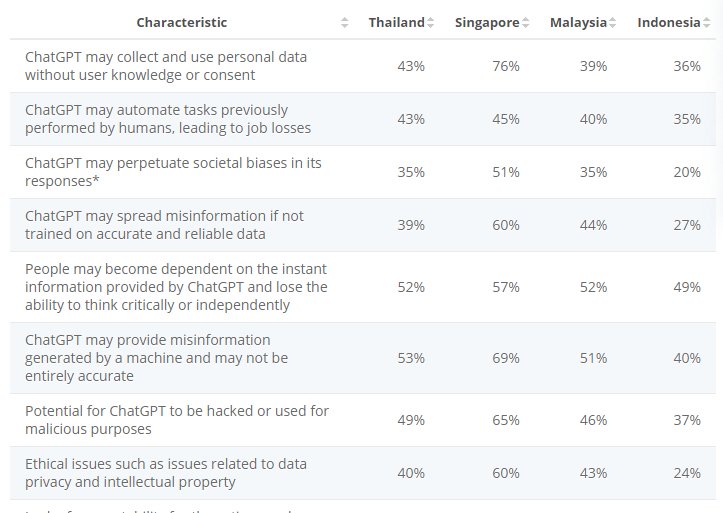
9. In four Southeastern Asian countries, 76% of respondents in Singapore say that collecting personal data is a serious concern they had using chatbots like Chatgpt compared to 36% in Indonesia. (Statista)
10. Researchers are concerned that, due to their capacity, ChatGPT models consume a lot of computational power and may have some deleterious effects on the ecosystem. (Science Direct)
11. Users have privacy concerns as OpenAI collects a wide variety of personal data. These may include IP address, browser type and settings, and data on users’ interactions with the site. (Research Gate)
12. 39% of business owners are worried that the copies and texts ChatGPT generates will lose a significant human touch. (Research Gate)
Looking Ahead: ChatGPT in 2024
As ChatGPT’s adoption rate continues to increase, the landscape is expected to evolve in 2024. Here’s what we can expect this year.
1. 33% of US companies planned definite staff layoffs due to ChatGPT adoption, while 31% said there was a strong probability of layoffs within five years. (ResumeBuilder.com, 2023)
2. 74% of users strongly believe that the chatbot will enhance already-existing technology. (Savanta)
3. 59% of males say they may use the AI chatbot to explore new tech in the future. (Savanta)
4. 15% of Boomers and above say that they could see themselves using ChatGPT for business purposes in the future. This is less than 37% of Gen Zers who say they could see themselves using AI for fun or pleasure in the future. (Savanta)
5. 14% of finance employees fear employers will use ChatGPT to reduce employees in their industry/company. Additionally, 51% of customer service and product management employees believe that their jobs are at risk with the increased adoption of ChatGPTl. (Sortlist)
6. Finally, Millennials are 43% more likely to worry about layoffs and AI’s impact on their workplace, particularly those that operate in tech finance and software. (Sortlist)
Hope these ChatGPT stats and trends help you make high-quality decisions for your brand or career.

About the author
Editorial Staff
The Editorial Staff at Bot Memo is a team of writers, analysts, and AI agents dedicated to mapping the global AI startup ecosystem. Led by Chintan Zalani, the team tracks thousands of funding rounds, classifies companies across verticals, and distills it all into actionable intelligence for investors and founders.