


Big data is a set of large amounts of data that are usually difficult to process or analyze due to their sheer volume.
It is usually characterized by the 3 Vs:
- Volume: The amount of data
- Velocity: The speed of data processing
- Variety: The number of types of data, whether structured or unstructured
Let’s move on to some interesting statistics on this impactful industry, beginning with key statistics.
On this page
- Key Big Data Statistics: Editor’s Choice
- The Global Big Data Analytics Market Is Expected to Grow to $962 Billion by 2032
- Remarkable Statistics on Internet Traffic Per Minute
- 66% of Consumers Worldwide Feel That Companies Have Too Much Access to Their Personal Data
- Big Data Growth Statistics
- A Combination of AI and IoT (AIoT) Will Rely on Big Data
- Big Data Statistics Across Different Sectors
- Big Data Statistics on Organizational Challenges
- Final Thoughts on The Future Evolution of Big Data
Key Big Data Statistics: Editor’s Choice
1. The average person produces 102 MB of data.
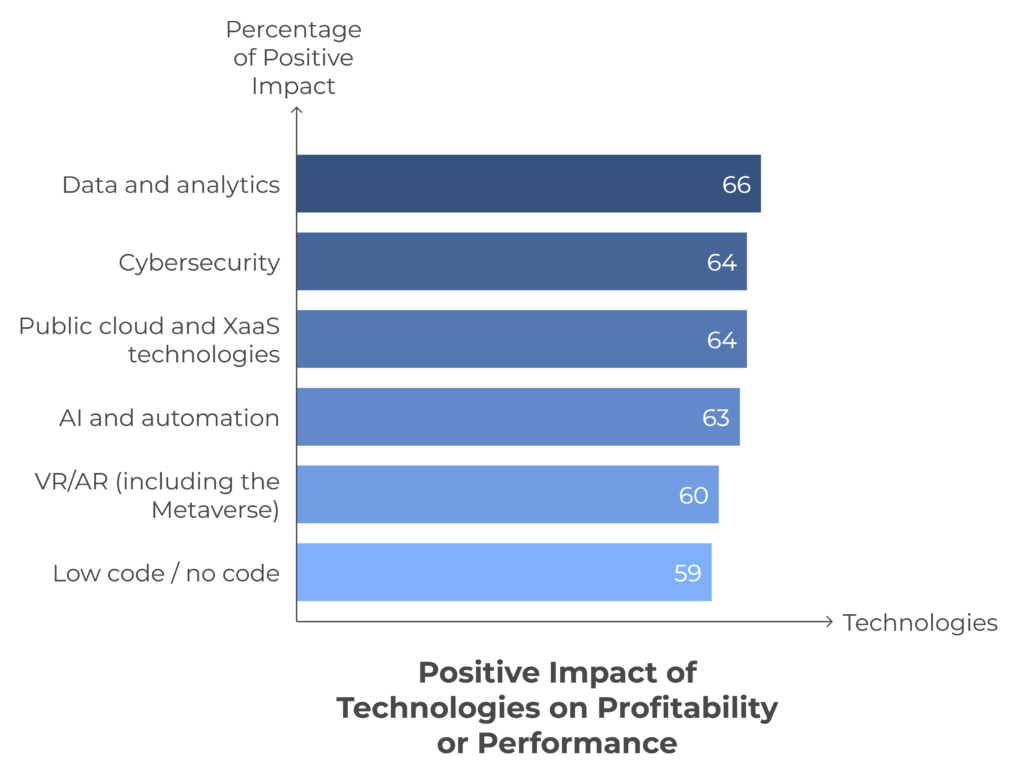
2. For 87.9% of businesses, investments in data and analytics are a top organizational priority.
3. Amazon shoppers spend $455,000 per minute.
4. 41.6 million messages are sent on WhatsApp per minute.
5. 91.1% of businesses are willing to prioritize data privacy if it increases customer trust.
The Global Big Data Analytics Market Is Expected to Grow to $962 Billion by 2032
According to Fortune Business Insights, the Big Data Analytics Market is set to reach a value of approximately $962 billion by 2032, growing at a CAGR of 13.5%.
North America Is Projected to Gain Maximum Revenue Share for the Next Decade
North America again dominates the Analytics sector.
BFSI Takes Up 22.8% of the Global Big Data Analytics Market Share
The Retail Segment though is expected to grow at the highest CAGR for the next decade.
For 87.9% of Businesses, Investments in Data and Analytics Are a Top Organizational Priority
However, when it comes to real-world results, only 37 percent said that their efforts for areas like improving data quality had been successful. (Statista, 2024)
29% of Businesses Have Seen a Profit of at Least 11 Percent From Investments in Data and Analytics
A further 26% have seen gains from investigation in artificial intelligence and automation. (KPMG, 2023)
Remarkable Statistics on Internet Traffic Per Minute
Have you ever wondered how much data is being transferred on the internet in a minute?
Here is a wonderful infographic by Domo, followed by some of their statistics, on how much data is sent on various platforms.
They also have relevant stats such as the number of Whatsapp messages sent, or the amount spent on Amazon.
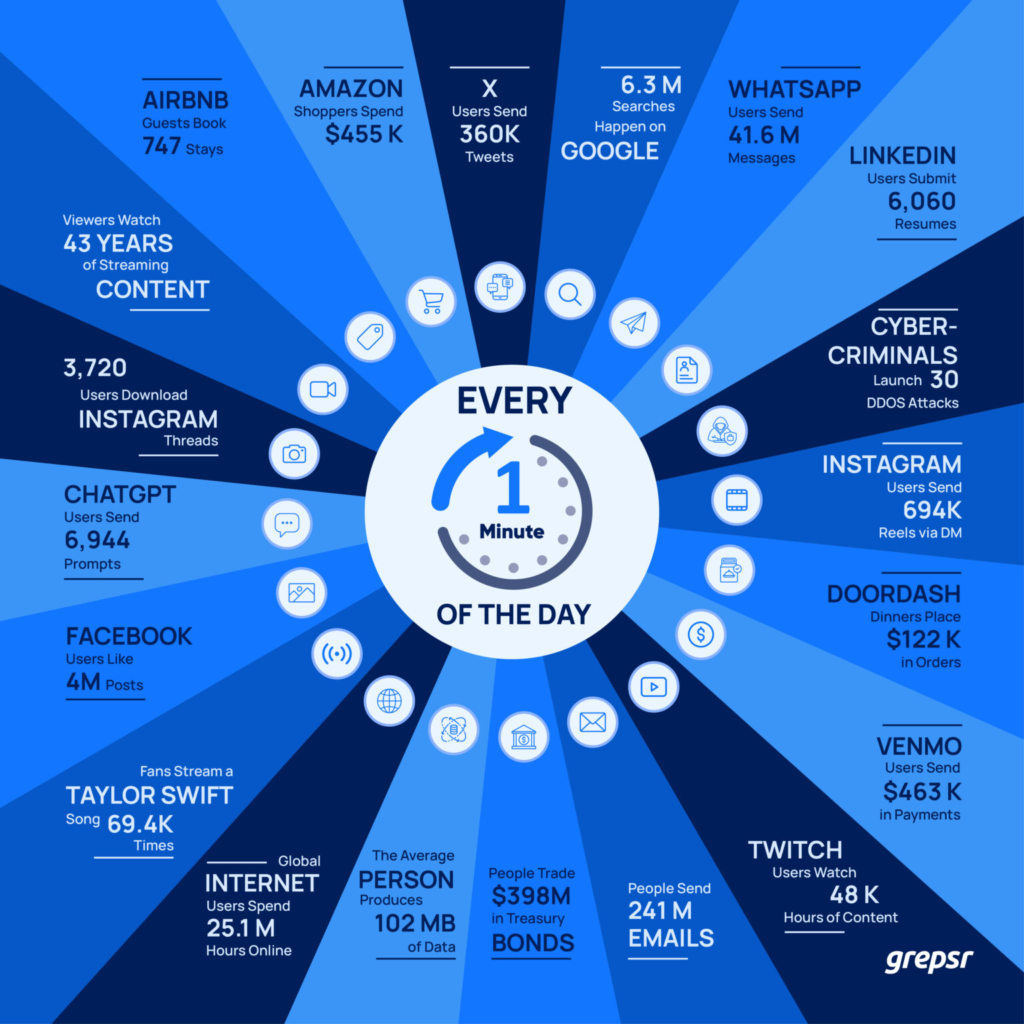
Here is what happens in one minute:
Amazon Shoppers Spend $455,000
It’s no surprise that Amazon is the fifth biggest company in the world in terms of market cap, and its CEO Jeff Bezos is currently the second richest man.
41.6 Million Messages Are Sent on WhatsApp
This shows how connected people are in the era of social apps.
The Average Person Produces 102 MB of Data
Most of the data produced on the internet is text, and so it’s in an unstructured format.
A Taylor Swift Song is Streamed 69.4k Times
When it comes to video content, viewers stream around 43 years of videos per minute.
Instagram Users Send 694K Reels Via DM
Users on Facebook like to make around 4 million posts during the same period.
66% of Consumers Worldwide Feel That Companies Have Too Much Access to Their Personal Data
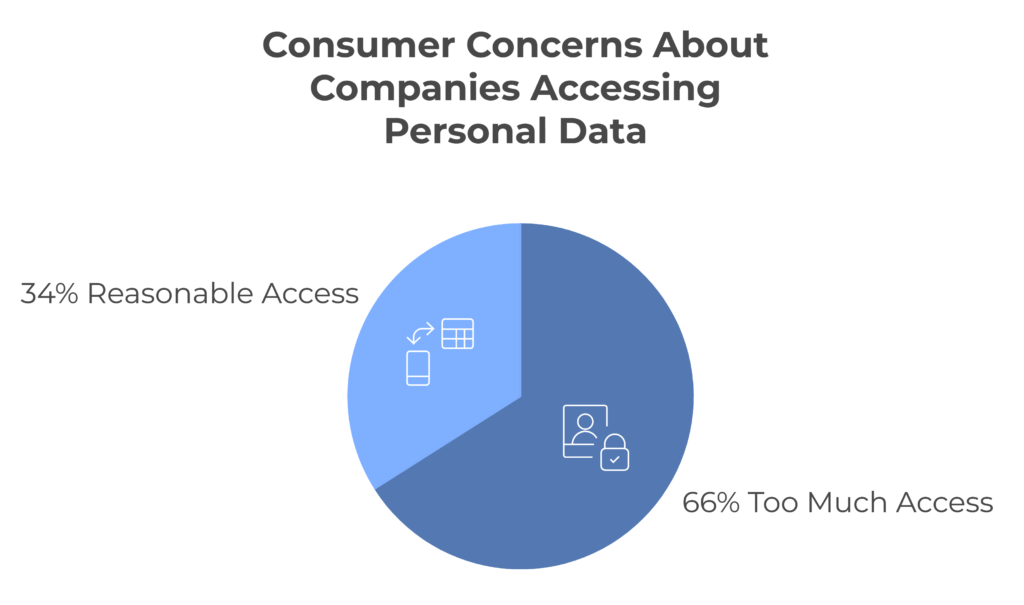
Privacy is a huge concern when it comes to sharing private data with apps like Facebook or X. (Statista, 2024)
78.1% of Businesses Didn’t Feel Hindered by Privacy Requirements
Yet the rest, or at least 1 in 5 businesses, feel restricted by privacy requirements. (Termly, 2024)
91.1% of Businesses Are Willing to Prioritize Data Privacy If It Increases Customer Trust
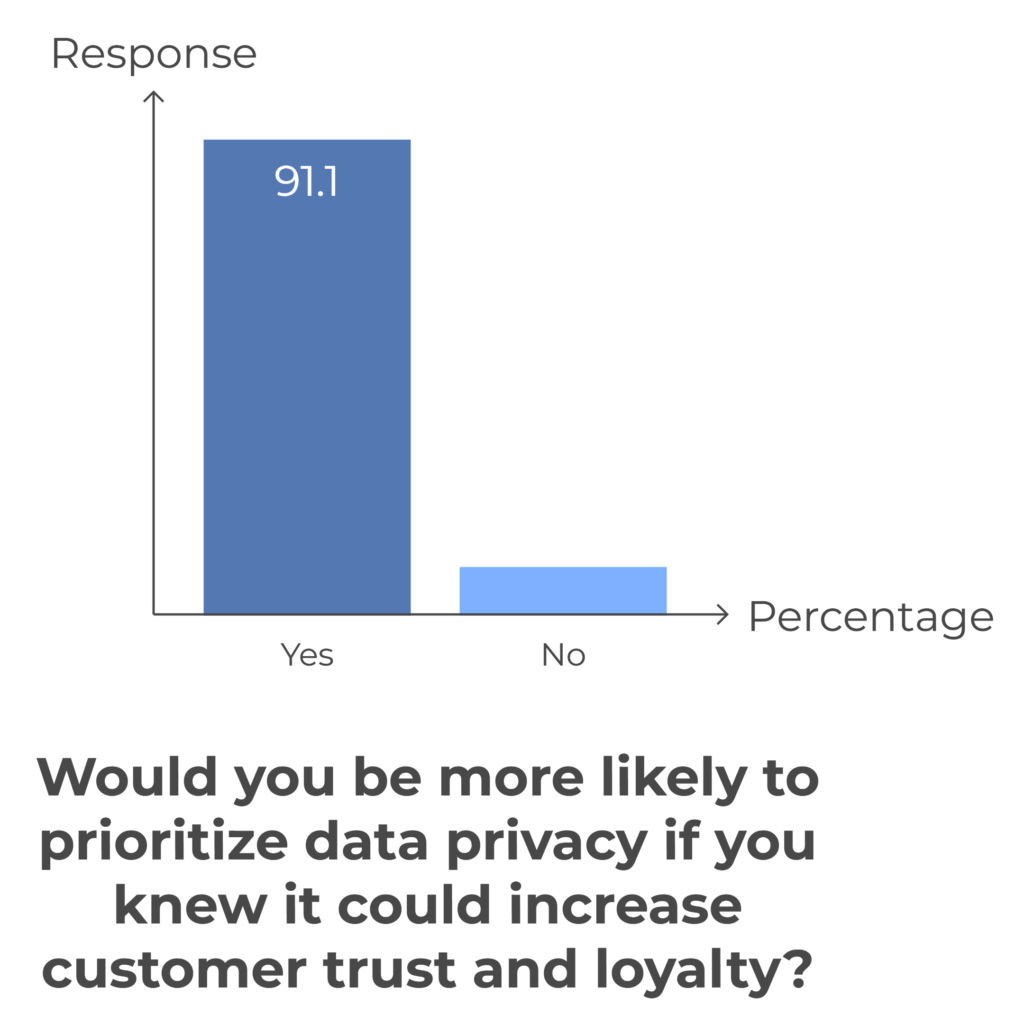
There’s also statistical data supporting that companies prioritizing data privacy does increase consumer trust. (Termly, 2024)
48% of Internet Users Have Stopped Shopping With a Company Over Privacy Concerns
63% of consumers also want companies to be more transparent about how their data is used. (Tableau, 2024)
Big Data Growth Statistics
There is a lot of expansion happening in various sectors of the big data industry, let’s take a quick look at the numbers.
Global Data Storage Is Projected to Surpass 200 Zettabytes by 2025
This includes data stored on private and public IT infrastructures, on utility infrastructures, on private and public cloud data centers, and on personal computing and IoT devices. (CyberSecurity Ventures, 2024)
Mobile Data Traffic Is Set to Exceed 167 Exabytes Per Month
This is caused by in part by the boom in IoT (Internet of Things) connected devices. (Statista, 2024)
In 2021, Netflix Users Consumed 140 Million Hours of Streaming Per Day
This was also during the pandemic years which could have inflated the usual numbers. (Domo. 2024)
Amazon Simple Storage Service (S3) Stored Over 100 Trillion Objects by 2021
This corresponds to a size of about 500 Exabytes. (NCBI, 2024)
The Hybrid Cloud Market Is Worth $130 Billion
It’s expected to grow at a high CAGR of 22.1% in the next 5 years, and is growing the fastest in the Asia-Pacific region. (Mordor Intelligence, 2024)
The Edge Computing Market Is Projected to Expand at A CAGR of 33%
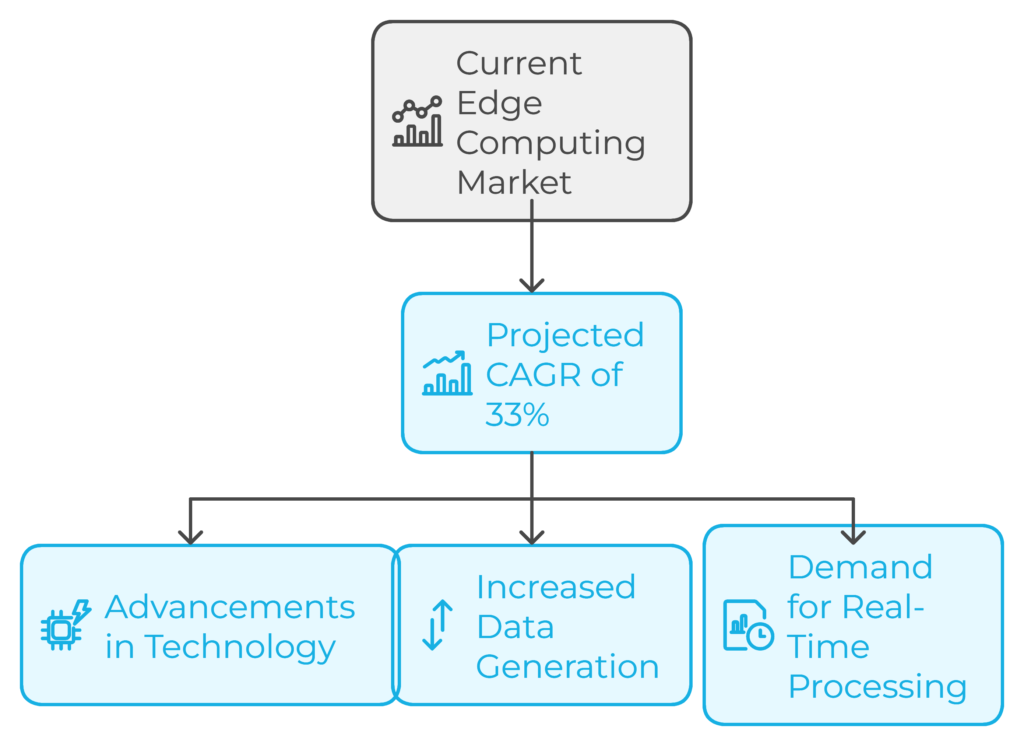
Edge computing is an IT architecture in which client data is made to be processed as close to the original source as physically possible. (Next Msc, 2021)
A Combination of AI and IoT (AIoT) Will Rely on Big Data
AIoT stands for Artificial Intelligence of Things, which is a combination of AI and Iot. It will be used to improve human-machine interactions and boost analytics.
AI and IoT Are Converging to Create Smarter Connected Devices
It is interesting to note that along with AI, IoT builds sophisticated machines that can mimic human behavior and can make decisions with little to no human input. (Straits Research, 2023)
The Asia-Pacific Region Represents the Second-Largest AI in The IoT Market Segment
It is Projected to Grow at a CAGR of 29.25%. (Straits Research, 2023)
A 2022 Vantage Survey Indicates That 97.0% of Participating Organizations Are Investing in Data Initiatives
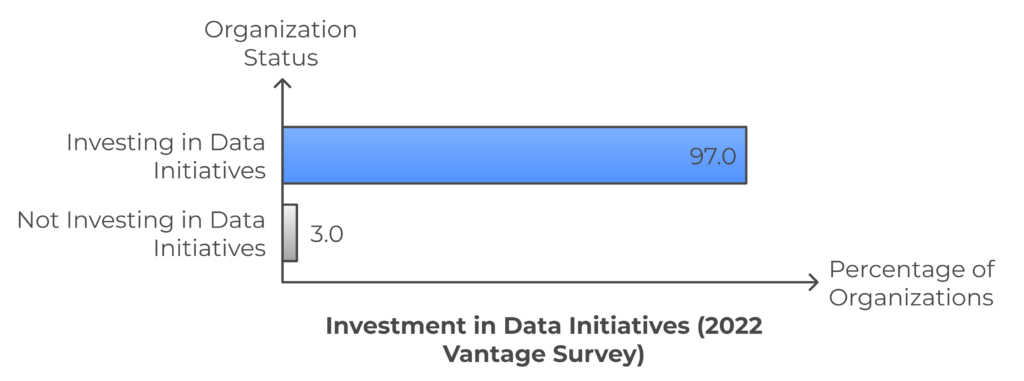
Futhermore, 91.7% of organizations are increasing that their investment in Data and AI initiatives. (Vantage Survey, 2022)
Big Data Statistics Across Different Sectors
Big Data is impacting sectors going from healthcare to manufacturing and communications.
Big Data Is Generating Approximately USD 300 Billion Value Per Year in the U.S. Healthcare Industry
Apart from the healthcare industry, retailers using big data could increase operating margin by more than 60%, according to McKinsey research. (McKinsey)
North America Leads the Global Big Data Analytics in Healthcare Market
They are also investing highly in advanced technologies, such as ML, the IoT, and AI. (Fortune Business Insights, 2024)
The Market Size for Big Data in Healthcare Is Estimated to Grow to USD 540 Billion by 2035
This represents a CAGR of 19.06% during the forecast period 2023-2035.(Roots Analysis, 2022)
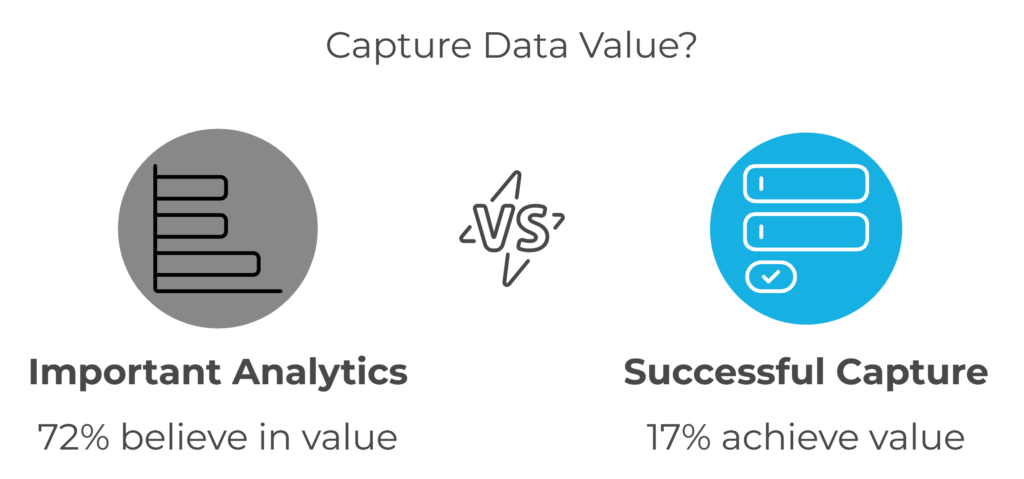
72% of Manufacturing Companies Believe Analytics Enhance Productivity
Although as it is different in practice, only 17% of the companies said that they had actually captured satisfactory value from it. (BCG-WEF, 2019)
60% of the Communications Sector Operationalizes Big Data
This is tied with 60% in Utilities/Chemicals, 55% in consumer and packaged goods, and 53% in Reta. (BCG-WEF, 2019)
Big Data Statistics on Organizational Challenges
Organizations seem to have trouble implementing big data technology, even when they hire data scientists, a lot of work time goes into data cleaning.
A Lack of Big Data Expertise Was the Top Challenge That Organizations Face
Technical know-how such as how to use and extract information from data lakes are in short supply. (At Scale,2024)
Only 17% of Manufacturing Companies Have Seen Value from Implementing Analytics
There are still issues with understanding how to best use AI and analytics technologies in the real world. (BCG-WEF, 2019)
Data Scientists Spend 39% of Their Time Transforming Raw Data into the Required Format
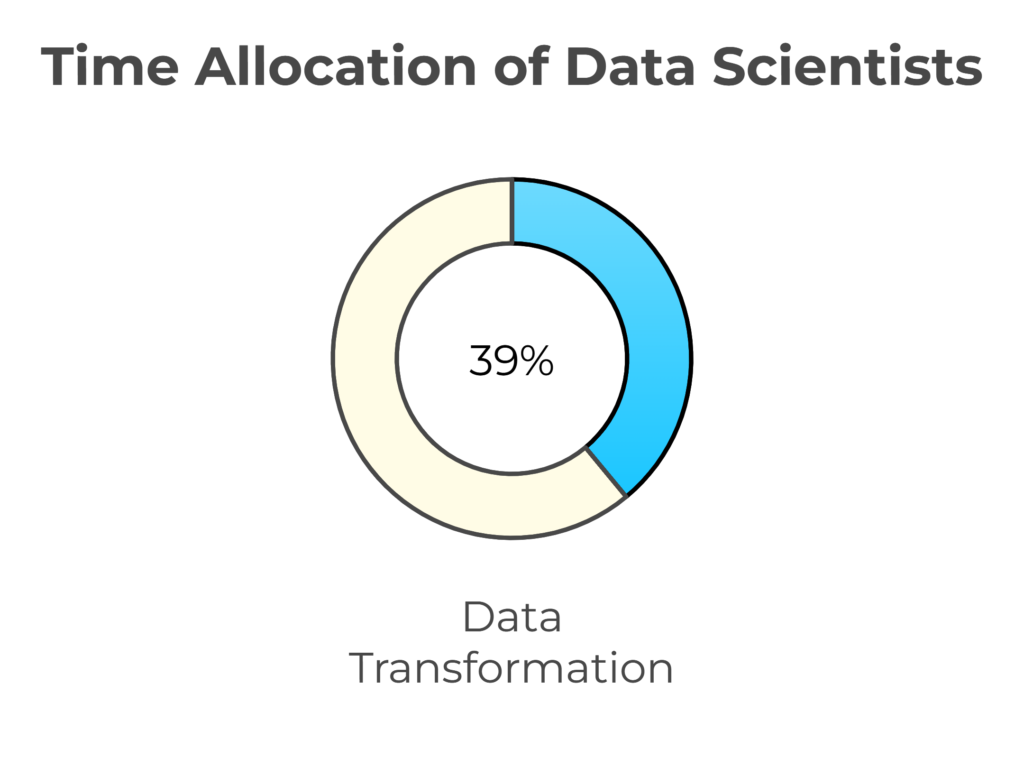
A lot of data science jobs require copious amounts of formatting to obtain structured data.
That’s more than they spend on data model selection, training, and deployment combined! (Anaconda, 2023)
Final Thoughts on The Future Evolution of Big Data
In the Journal of Big Data, it’s mentioned that big data technologies can have very positive impacts on the healthcare industry.
Big data analysis of Electronic Health Records is improving patient prognosis.
Various biomedical and healthcare tools such as genomics, mobile biometric sensors, and smartphone apps are already generating a huge amount of valuable data.
Apart from healthcare, the need for hardware/software that can handle future data demands is increasing, with an emphasis on technologies Edge computing.

About the author
Editorial Staff
The Editorial Staff at Bot Memo is a team of writers, analysts, and AI agents dedicated to mapping the global AI startup ecosystem. Led by Chintan Zalani, the team tracks thousands of funding rounds, classifies companies across verticals, and distills it all into actionable intelligence for investors and founders.