
The top AI use case right now is article writing.
Chatbots such as ChatGPT and Claude receive millions of queries every single day, so we can presume a huge volume of AI text is generated each day.
How does AI writing software impact writers? Could content creation jobs be at risk?
Let’s find out the answers to these questions, with an overall glimpse of the AI writing market as well.
On this page
AI Writing Statistics: Editor’s Picks
Here are some of the most relevant stats:
1. 65.8% of people think that AI content is equal to or superior to human-generated content.
2. 63% of people are worried about inaccuracies in AI-generated content.
Yet human-generated content has much more credibility and trust.
3. The global market for Generative AI in Content Creation is expected to garner a 31.2% CAGR and reach a size of USD 175.3 billion by 2033.
Here we can see the content-generating AI market grows at a pretty high rate.
4. 75% of marketers report that generative AI facilitates a higher output of content than would be possible without it. (Market.us, 2024)
5. 77% say that it streamlines content creation more efficiently.
6. Moreover, 79% concur that generative AI enhances the quality of content produced.
7. Key Players: Major players in the Generative AI in the Content Creation Market include OpenAI, IBM Corporation, NVIDIA Corporation, Adobe Inc., Microsoft Corporation, and Google LLC.
Benefits of AI-Assisted Writing
Let’s look at the various ways in which AI can benefit the writing process:
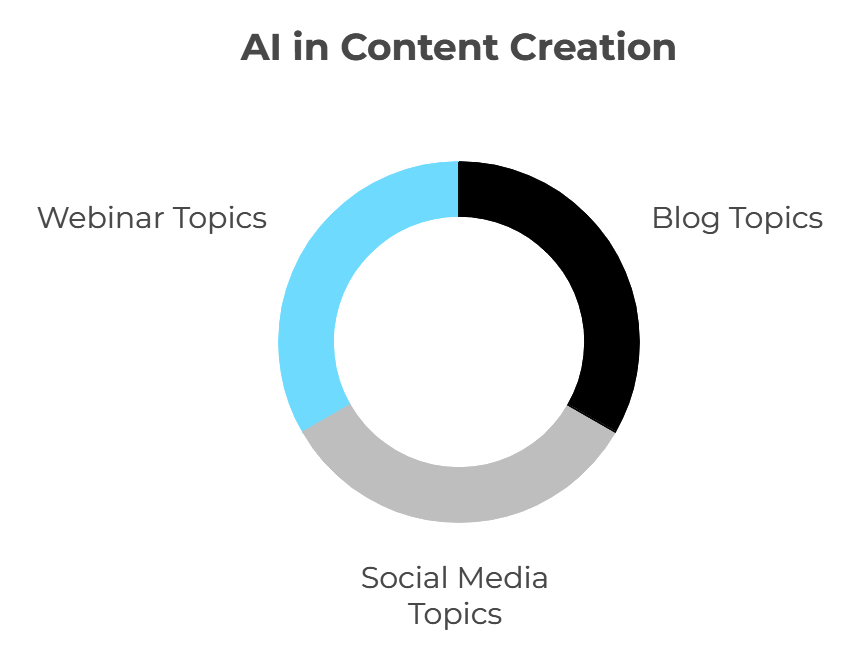
1. For content creation, AI is used to ideate blog, social, and webinar topics. (Forbes, 2023)
2. AI can help you save time doing research by pre-drafting your content, however, you can’t entirely trust the output you get from AI software. (Forbes, 2023)
AI writing tools are prone to ‘hallucinations’, where they make up illusory data or facts that aren’t grounded in reality.
3. When writing content for business, AI can assist with brainstorming and basic content creation, phrasing, and formatting. (Forbes, 2023)
4. AI can help you find relevant information very quickly and help you integrate it with your work. (Forbes, 2023)
Yet, there’s also research that shows no clear benefit to using AI for content marketers:
5. While 43.8% of content marketers using AI reported above-average success, so did 48.6% of those who aren’t using AI. (Siege Media, 2024)
6. Humans still perform better when it comes to being very successful, where — 20.9% of users reported high levels of success without AI, while only 12% with AI. (Siege Media, 2024)
Writing success also correlates with a higher amount of spending per post:
7. A business that spends more than $4,000+ per post is about 2.6 times as likely to report its strategy as “very successful” than a business that spends $0-$500. (Siege Media, 2024)
8. About 20% of businesses spending $0-$500 reported their strategy underperformed slightly, while 0% of businesses spending at least $4,000 did. (Siege Media, 2024)
Hence, AI is more effectively used for brainstorming and making the writing process less time-consuming instead of directly substituting writing with content generated by AI.
AI Adoption in Writing Statistics
How has AI already been adopted in the industry?
It turns out already a majority of content creators in the industry are already taking help from AI tools.
Let’s look at some of these AI applications.
What Percentage of Writers Use AI?
1. 85.1% of marketers are using AI for article writing. (Authority Hacker, 2024)
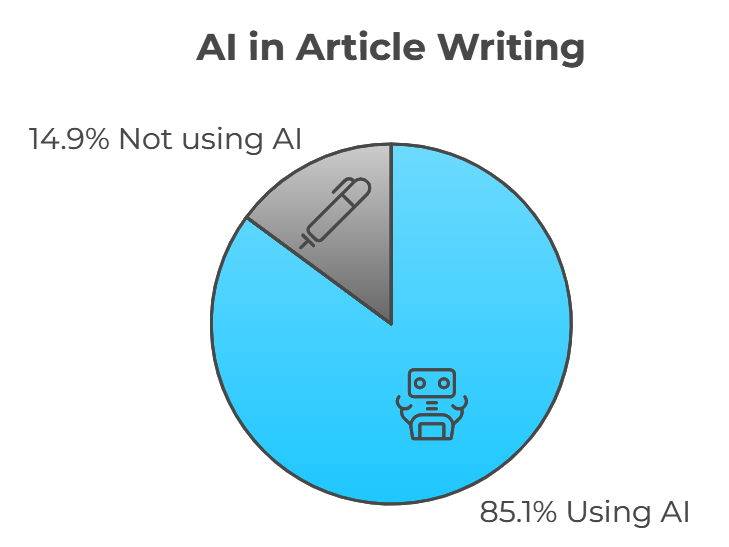
This is quite a substantial percentage!
2. 75.7% of marketers are now using AI tools for work. (Authority Hacker, 2024)
3. 49.5% of marketers use AI tools frequently, (every few days or so). (Authority Hacker, 2024)
30.3% of marketers use AI tools daily, while another 33.8% say they use them at least once a week.
4. 85.1% of AI users are using AI for creating content for blogs. (Authority Hacker, 2024)
Article writing is the number one use-case for AI around 85% using AI for that.
5. 32.9% of businesses have already replaced some human tasks with AI solutions.
Can AI Writing Be Detected?
AI writing cannot be detected with 100% certainty, yet some AI detection models on the market achieve a very high accuracy.
1. A model developed by researchers at the University of Kansas demonstrated 99% accuracy in differentiating human writing from texts produced by ChatGPT, and it significantly outperforms the GPT-2 Output Detector, AI detection software that was offered by OpenAI. (Science Direct, 2023)
2. Turnitin, another famous AI model, correctly identified 28 of 30 samples in this category, or 93%. (Temple University, 2024)
Are Students Using AI for Homework?
Is the age-old tradition of doing homework outdated with the advance of AI?
Quite a lot of students are leveraging these tools to do homework, with around 3% even using them for 80% or more of the work.
1. Turnitin reviewed over 200 million papers for AI writing. About 11% of papers had at least 20% AI writing present and about 3% had at least 80% AI writing present. (Turnitin, 2024)
2. Traces of chatbots have even been found in peer-reviewed, published academic writing. (Wired, 2024)
ChatGPT usage in academic papers becomes an issue of negligence to academic standards, especially if it’s used to generate content for most of the work.
3. Students have submitted more than 22 million papers that may have used generative AI in the past year, new data released by plagiarism detection company Turnitin shows. (Turnitin, 2024)
According to a survey by BestColleges.com:
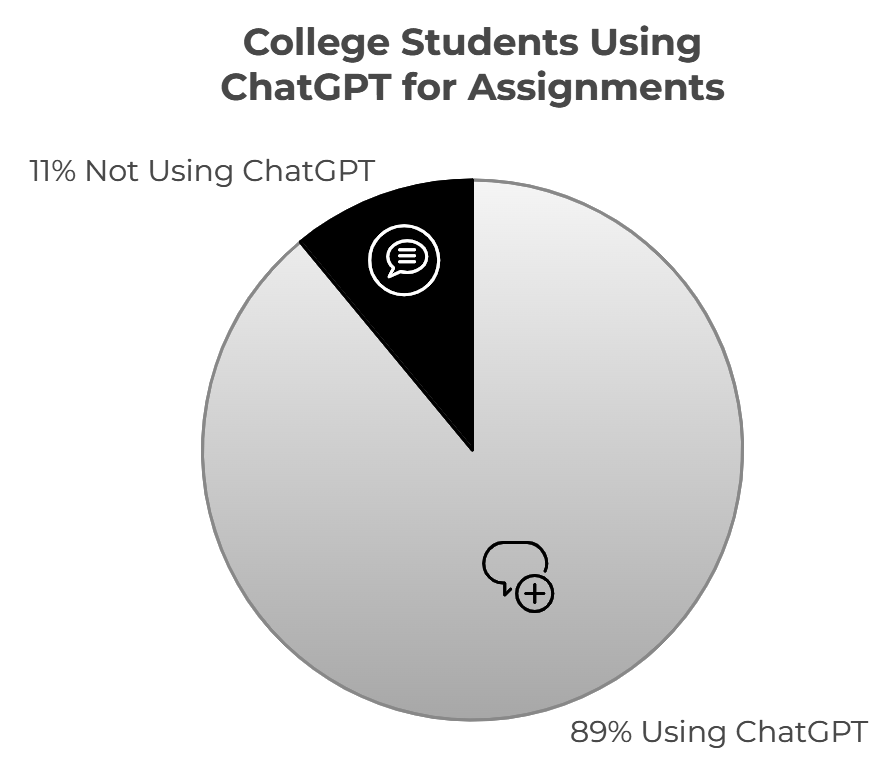
4. 89% of college students have admitted to using ChatGPT to help with assignments. (Best College, 2023)
5. Educators were more stringent with 34% believing the software should be banned, while 66% support students having access. (Best College, 2023)
6. Among students who say they’ve used AI tools for schoolwork:
- 50% use these tools for some parts but complete the majority themselves. (Best College, 2023)
- 30% use AI for the majority of their assignment. (Best College, 2023)
- 17% use AI to complete an assignment and then turn it in with no edits. (Best College, 2023)
Students seem to be becoming very reliant on AI tools if they submit work without any proofreading or edits after the AI has generated it.
Which AI Tools Are Best for Writing?
1. Jasper AI: Jasper creates AI content in various forms using a multi-modal AI engine, some of its features are:
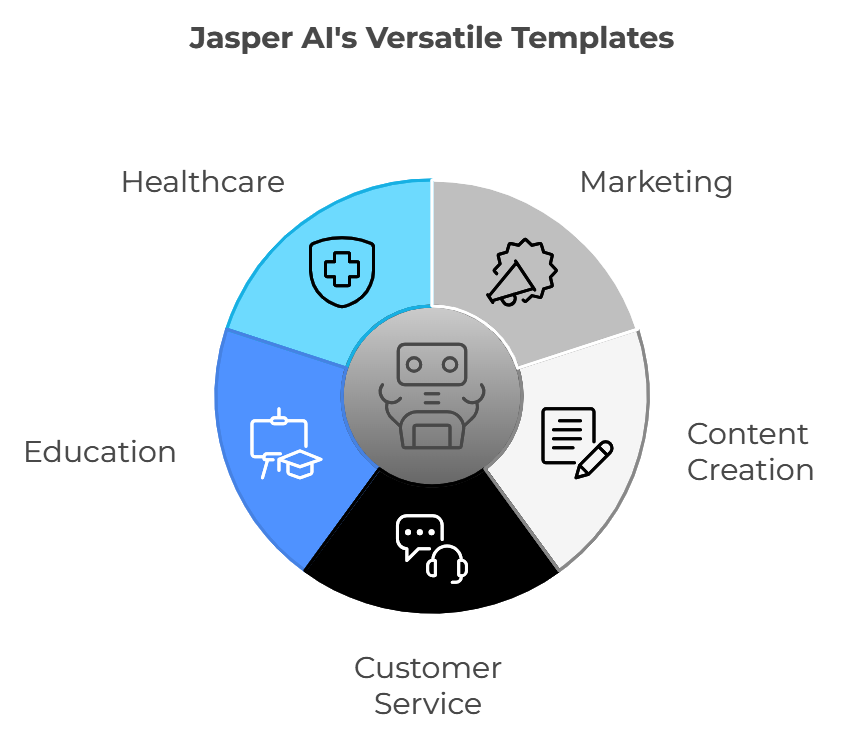
- It has 50+ AI templates that are created specifically for industry use-cases. (Jasper Templates, 2024)
- It contains analytics that help you gauge the performance of your content and tell you which pieces need revisions, and which ones are doing great. (Jasper Features, 2024)
- Jasper provides API services that can directly be integrated on your platform, and can be customized to mimic a brand’s voice or style. (Jasper API, 2024)
- As an API provider, Jasper has 99.99% uptime. (Jasper API, 2024)
2. Frase: Frase is a tool that provides SEO-optimized AI-generated content, here are some key features:
- Analyze SEO competitors’ content easily via an intuitive research panel. (Frase, 2024)
- Visualize key SERP metrics like word count, domain rating, and heading count. (Frase, 2024)
- Use AI to generate full-length, optimized content briefs in 6 seconds. (Frase, 2024)
As we have seen in previous articles on AI in SEO though, (link here), Google punishes AI content that is manufactured with the sole goal of optimization at the cost of quality.
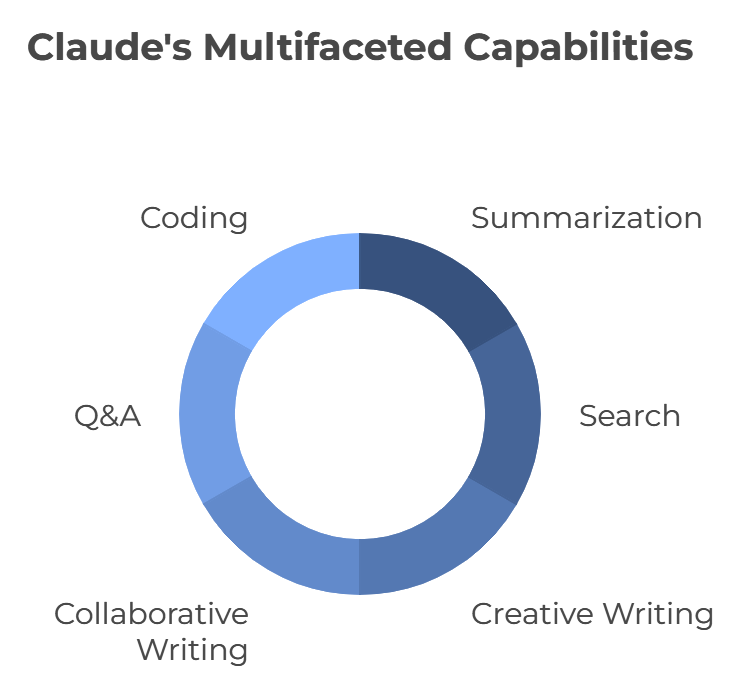
3. Claude: Claude is an AI-Assistant developed by Anthropic, that helps with summarization, search, creative and collaborative writing, Q&A, coding, and more.
- Claude 3 was the first model which exhibited “character training”. The goal of character training is to make Claude begin to have more nuanced, richer traits like curiosity, open-mindedness, and thoughtfulness in its outputs. (Anthropic, 2024)
- Multilingual Processing: Claude can translate between various languages in real-time, practice grammar, or create multi-lingual content. (Anthropic, 2024)
- “Users describe Claude’s answers as detailed and easily understood, and they like that exchanges feel like natural conversation,” says Autumn Besselman, Head of People and Comms from Quora. (Anthropic, 2024)
Global AI Usage Statistics
Let’s look at some broader statistics on the general AI market, to get an estimate of the growth of this sector.
The generative AI market is expected to grow to USD 1.3 trillion in the coming decade, achieving a USD 40 billion market size by 2022. (Bloomberg, 2023)
Here is a chart by Fortune Business Insights forecasting the growth of Artificial Intelligence in North America, projected till 2032.
The market share is currently distributed as so:
Software platforms dominate 65.4% of the AI Market share. (Fortune Business Insights, 2024)
Natural Language Processing (NLP) Market Size was valued at USD 50.9 billion in 2021. (Market Research Future, 2024)
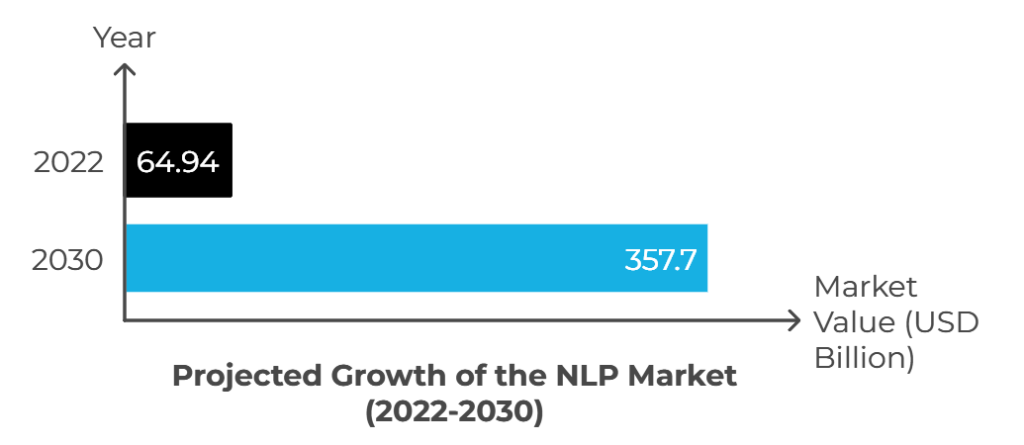
The natural language processing (NLP) market industry is projected to grow from USD 64.94 Billion in 2022 to USD 357.7 billion by 2030, exhibiting a compound annual growth rate (CAGR) of 27.6% during the forecast period (2024 – 2030). (Market Research Future, 2024)
Based on the technology, natural language processing (NLP) market segmentation includes auto-coding, text analytics, pattern & image recognition, and speech analytics. (Market Research Future, 2024)
AI Content Marketing Statistics
How do AI content generation tools assist the content marketing industry? Let’s look at some AI statistics on that.
First off, how are content marketers using artificial intelligence?
Brainstorming and content ideation leads the tally with around 70% of marketers using it for that. (Siege Media, 2024)
Strategy and drafting the content itself come second. (Siege Media, 2024)
Has Spending on Content Marketing Increased From 2023 to 2024?
- More than half of businesses (54.5%) plan to spend more on content marketing in 2024 than in 2023. (Siege Media, 2024)
- Overall, businesses are spending more on their content per month in 2024 than in 2023, although fewer businesses spend more than $45K monthly. (Siege Media, 2024)
- Increased spending per post strongly correlates with success level — a business that spends more than $4,000 or more per post is about 2.6 times as likely to report its strategy as “very successful” than a business that spends $0-$500. (Siege Media, 2024)
Only 14.03% of Users Trust Keyword Data From AI Tools
While 5.7% of people do not trust it, 39.4% have doubts and 40.9% say that it is still pretty accurate. (Authority Hacker, 2024)
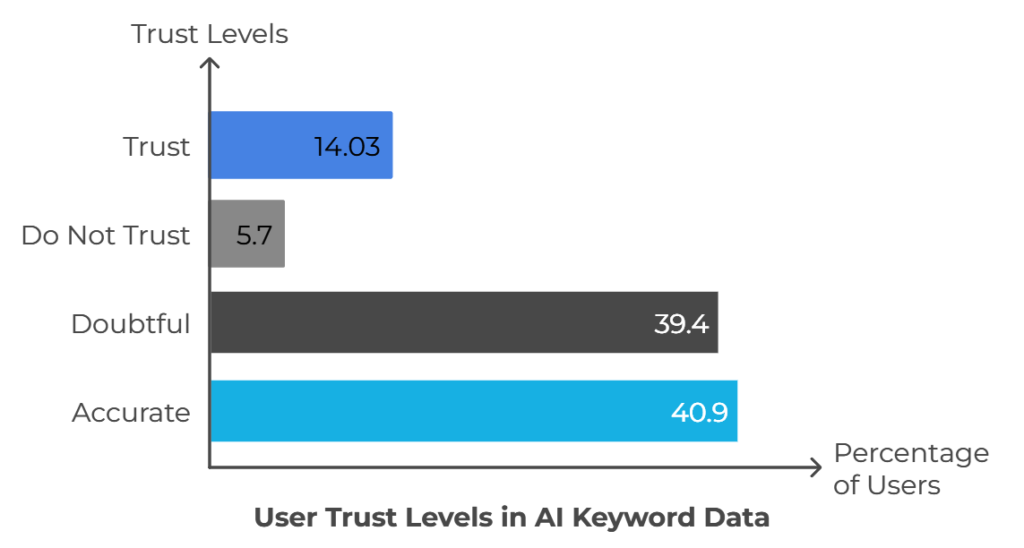
This is understandable as it’s easy to replicate a scenario where AI simply makes up the data. If you ask AI to find keywords and their volumes for several keywords related to a topic, you’ll likely get completely different numbers each time.
While 100% accuracy is impossible, AI’s wild data variances leave users skeptical, and rightfully so.
Stats Around AI’s Impact on The Writing Job Market
Has AI Taken Over Writing Jobs?
Job security is an important factor to consider in the AI market. While there seems to be a decrease in hiring for writers, let’s explore the stats further to get a clearer idea.
Will ChatGPT Replace Novelists?
Can mere prompt engineering create entire novels, replacing the need for human-written content?
Can ChatGPT learn how to add a human touch to stories we all love?
Let’s find out the opinions of the writers themselves on this issue.
Around 50% of writers are only marginally concerned, while 32% are optimistic about the future of freelance writing. Only 15% are very concerned. (Jennifer Gregory, 2023)
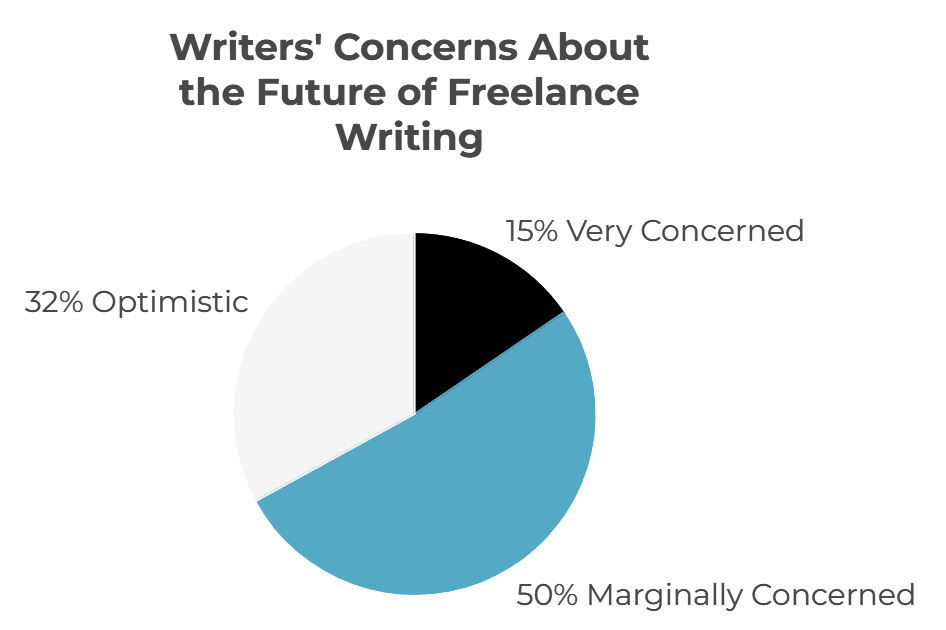
The results are more mixed here, with around 60% saying they would make more money or stay at the same level, with the other 40% expecting a declining salary. (Jennifer Gregory, 2023)
Coincidentally, most writers (61.7%) are earning the same or more a year from when the survey was taken. Almost 20% of respondents are earning significantly more money than in past years. (Jennifer Gregory, 2023)
AI might not be the only reason freelancers earn less, sometimes they might choose fewer hours or have other priorities.
According to hours worked, let us see the income distribution of them:
The top 30% make more than 5k a month, (which translates to around the average US salary per year of $65470), while the rest make less than 5k. (Jennifer Gregory, 2023)
While if you worked more than 25 hours, 63% make above 5k per month.
In another study:
The freelance market itself wasn’t negatively affected, with Upwork gaining a 14% increase in year-on-year revenue. (Upwork, 2023)
The number of writing jobs declined by 33%, translation jobs declined by 19%, and customer service jobs declined by 16%. (Bloomberry, 2024)
Chatbots, with the number of jobs related to developing chatbots exploding by 2000% since the release of ChatGPT and the OpenAI API. (Bloomberry, 2024)
Final Thoughts on The Future of AI Writing
The future of content writers’ jobs may not be as bleak in the face of AI, according to Forbes Content Writer Noa Eshed.
“As business productivity increases and the need for repetitive tasks diminishes, content creators have to ready themselves and make AI their friend to retain their competitive advantage, as their roles will be reconfigured,” she says.

About the author
Editorial Staff
The Editorial Staff at Bot Memo is a team of writers, analysts, and AI agents dedicated to mapping the global AI startup ecosystem. Led by Chintan Zalani, the team tracks thousands of funding rounds, classifies companies across verticals, and distills it all into actionable intelligence for investors and founders.