


What does it take to be successful in the AI startup scene today?
Let’s look at some of the key features of AI startups, such as funding, global hotspots, the number of unicorns, and even a dive into a unique case study.
So, let’s get started.
On this page
- Key Statistics on AI Startups: Editor’s Choice
- What is The Success Rate of AI Startups?
- How Many AI Startups Are There?
- AI Funding in 2024: Record-Breaking Investments and Trends
- AI Valuation Trends
- The AI Startup Ecosystem: Global Hotspots
- Top Challenges Faced by Startups in Implementing AI
- AI Startup Case Study: A Deep Dive into Anthropic's Journey
- Final Thoughts on The Path Ahead for AI Startups
Key Statistics on AI Startups: Editor’s Choice
1. In 2024, 35% of every dollar invested in American startups went to an AI-related company, a record share.
2. The US ranks the highest in terms of the number of AI startups with 4643 as of 2022.
3. In Asia, China leads with 24 out of the Top 50 AI Startups in Asia, followed by India with 10 and Japan/South Korea with 4.
6. Open AI leads as the AI startup with the highest amount of equity funding with $14 billion in 2023.
What is The Success Rate of AI Startups?
For startups in general, according to Startup Genome, around 90% fail.
How do AI startups fare better?
It appears that they do fare slightly better, with a 15% success rate.
Do 85% of AI Projects Fail?
For the year 2022, Gartner predicted in 2017 that 85% of AI projects won’t be successful in their task due to bias in data, algorithms, or the teams responsible for managing them.
As this is an older survey, there might be major improvements in these areas that could revise this prediction for the future.
How Many AI Startups Are There?
There are more than 90,000 companies in the AI space, where an AI company is defined as one that develops tech enabling machines to exhibit human-like intelligence. (Tracxn, 2024)
AI Growth and Market Size
Let’s look at the future projections as well as the market size of the companies in the AI space, as per Statista:
1. The market size in the Artificial Intelligence market is projected to reach US$184.00bn in 2024.
2. The market is expected to grow at a 28.46% CAGR from 2024 to 2030. By 2030, it will be worth $826.7 billion.
3. Globally, the largest market size in AI will be in the United States (US$50.16bn in 2024).
AI Funding in 2024: Record-Breaking Investments and Trends
1. In 2024, 35% of US startup investment went to AI-related companies, the highest share on record. (Crunchbase, 2024)
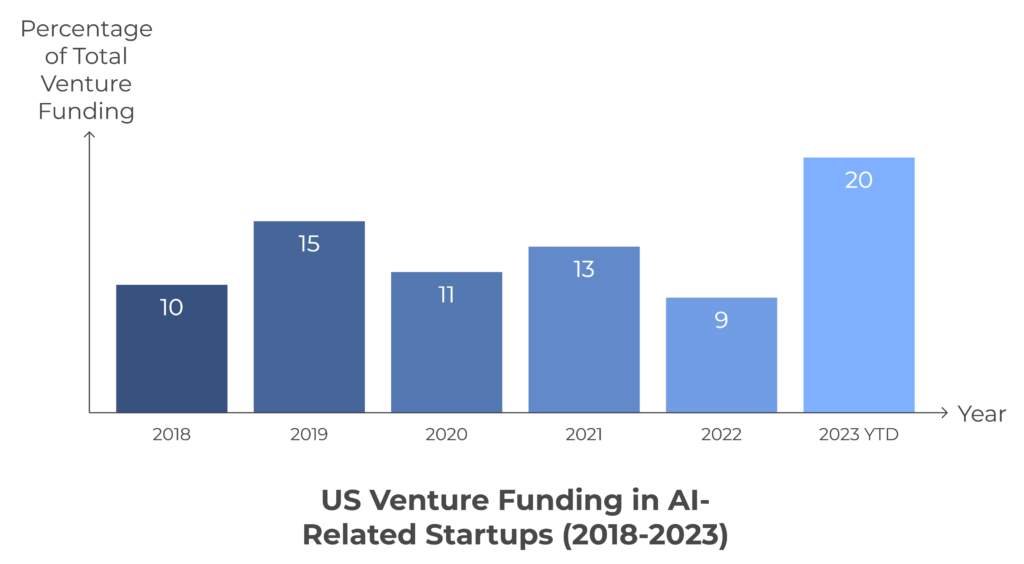
2. Funding in generative AI soars in early 2024, with companies like Elon Musk’s xAI, Mistral, and Wiz receiving massive fund-raising deals:
- xAI raised $6 billion in its series B funding in May 2024, its current valuation is $24 billion
- Mistral eyes a $600 million raise for a potential $6 billion valuation, 3 times its December 2023 valuation of $2 billion
- Wiz raised around $1 billion at a $12 billion valuation
3. Compared to 2022, funding for generative AI in 2023 was 5 times greater, while the number of deals made increased by 66%. (CB Insights, 2023)
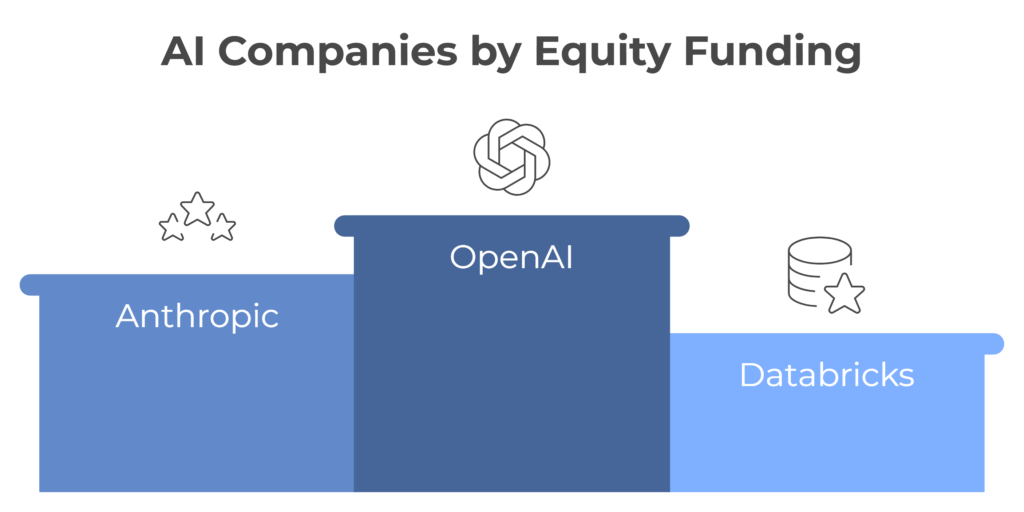
The Largest Funding Rounds Went to Generative AI Companies Including Openai, Anthropic, and Databricks
4. Here are their funding round details and current valuation, as per CB Insights:
- OpenAI leads with $14 billion in equity funding, valued at approximately $90 billion
- Anthropic comes next with $4.2 billion in equity funding, valued at $4.6 billion
- Databricks ties with Anthropic at $4 billion in equity funding, valued at $43 billion
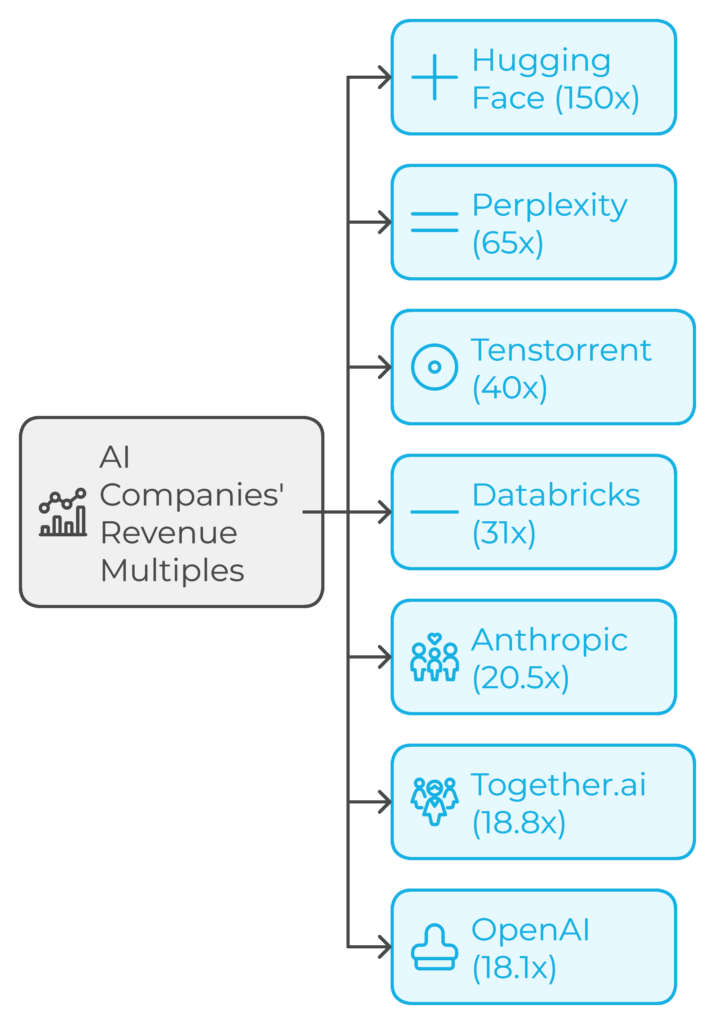
5. Hugging Face carried one of the highest revenue multiples, reported at more than 100x annualized revenue at its August 2023 round, where revenue multiple is the ratio of a company’s valuation to its annual revenue. (Sacra, 2023)
The Global Multimodal AI Market Is Expected to Reach $8.4 Billion by 2030
1. As per a study by KBV Research / ResearchAndMarkets, the global multimodal AI market is expected to grow at a 32.3% CAGR between 2023 and 2030, reaching $8.4 billion.
Here’s one popular use case of the multi-modality, according to the study.
2. Any problem where you want to use images or audio to answer questions can be facilitated by multi-modality, says Mirella Lapata, Professor at the University of Edinburgh.
3. Here is a blog post from Amazon detailing how a financial analyst can use its Multi-modal AI services to gain financial insights.
AI Valuation Trends
Let’s look at some interesting insights from a JP Morgan article on how the valuation trends in AI.
- Since 2023, AI-connected stocks have delivered 30% better returns than popular global indexes
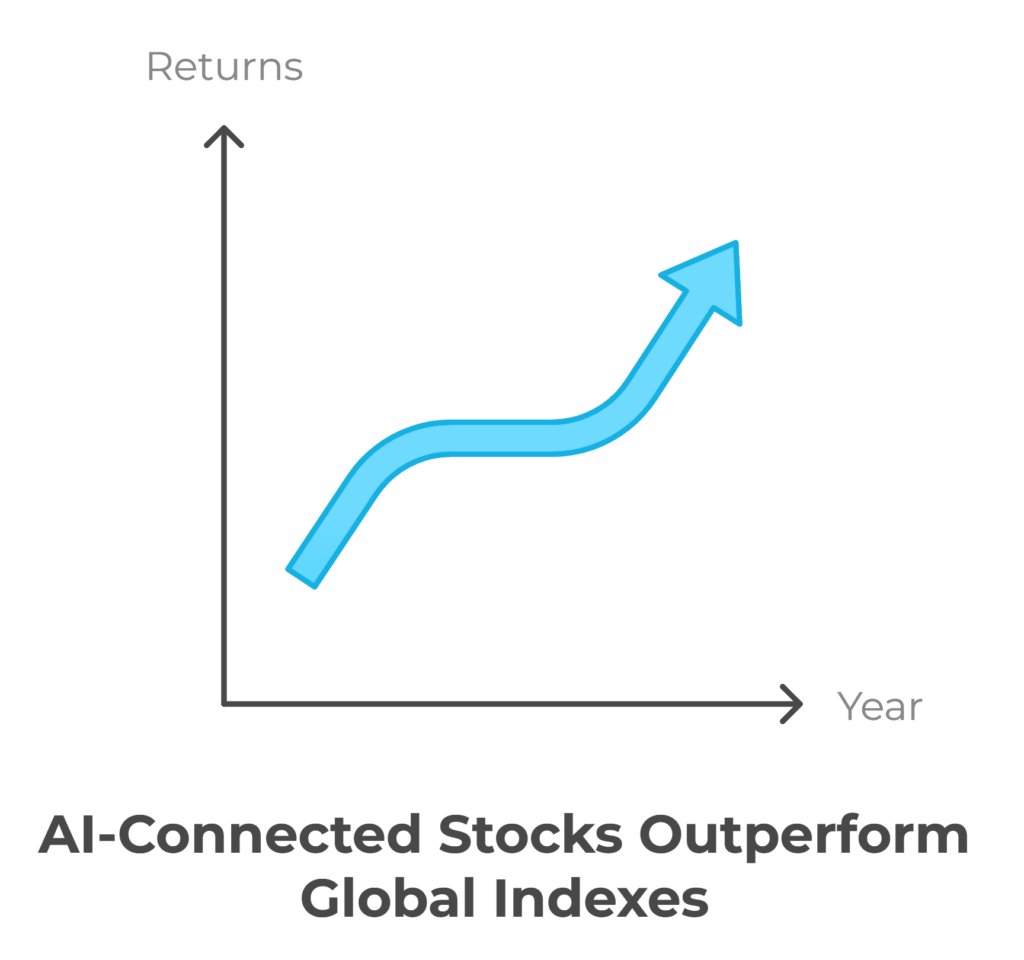
- When compared to the tech valuations during the Dot.com bubble, today AI companies have lower valuations with higher growth expectations
- Infrastructure such as cloud capacity and GPU are also set to be in high demand, with Nvidia estimating the demand for its GPUs reaching $2 trillion
Unicorns cover 20% of the 2024 AI Cohort.
This year, according to CB Insights, the 2024 AI 100 Cohort includes 19 unicorns at a $1B+ valuation.
Which company has the highest valuation per employee?
The highest valuation per employee, Sakana.AI– a company that employs 3 people and works in nature-inspired computing, leads with $66.7 million.
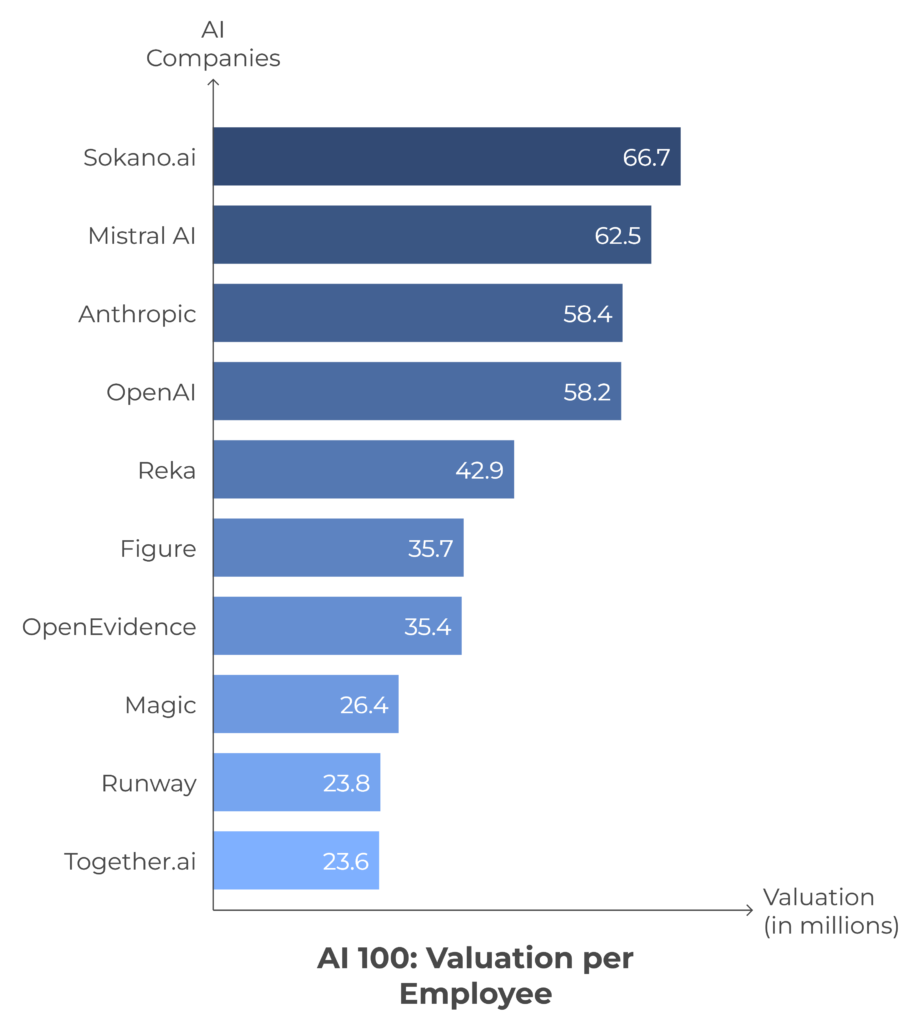
They are closely followed by Mistral and Anthropic at $62.5 million and $58.4 million respectively.
Are We in an AI Bubble?
An equity bubble is characterized by unreasonable and speculative projections of growth, that are likely driven by hype rather than financial analysis.
1. In financial terms, a high P/E ratio usually indicates excess optimism.
So, could the Dot.com Bubble burst situation be in the cards for AI?
2. The growth of AI stock prices doesn’t compare with the sudden jump in tech prices seen in the 2000s.
3. For leading tech companies in 2024, the P/E ratios are lower than in 2000 (34x versus 59x) and the expected growth is higher (42% versus 30%).
4. In summary, from the analysis done by JP Morgan, they don’t consider AI to be in a bubble right now.
The AI Startup Ecosystem: Global Hotspots
1. According to Visual Capitalist, the US leads the AI startup market with 5509 startups founded in the decade of 2013-2023.
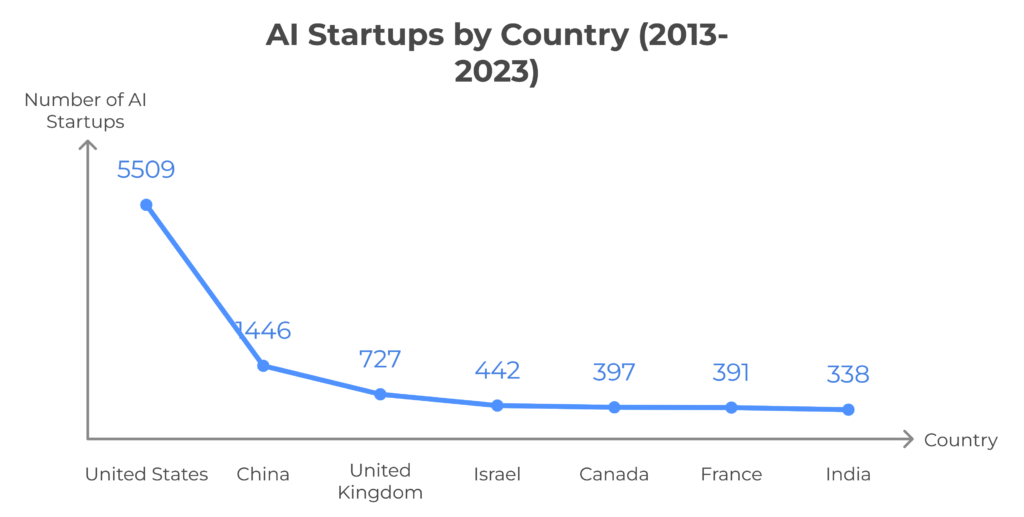
2. China comes second with 1446 startups, followed by the UK (727) and Israel (442).
The US has the largest AI market size as well.
3. In global comparison, the largest market size i AI will be in the United States (US$50.16bn in 2024). (Statista, 2024)
4. In Asia, China leads with 24 out of the Top 50 AI Startups in Asia, followed by India with 10 and Japan/South Korea with 4. (Business Korea, 2024)
AI Patents By Country
From data taken by Stanford’s AI Index Report, here is a graphic on the number of AI patents from China, the US, the EU the UK, and the Rest of the World (RoW).
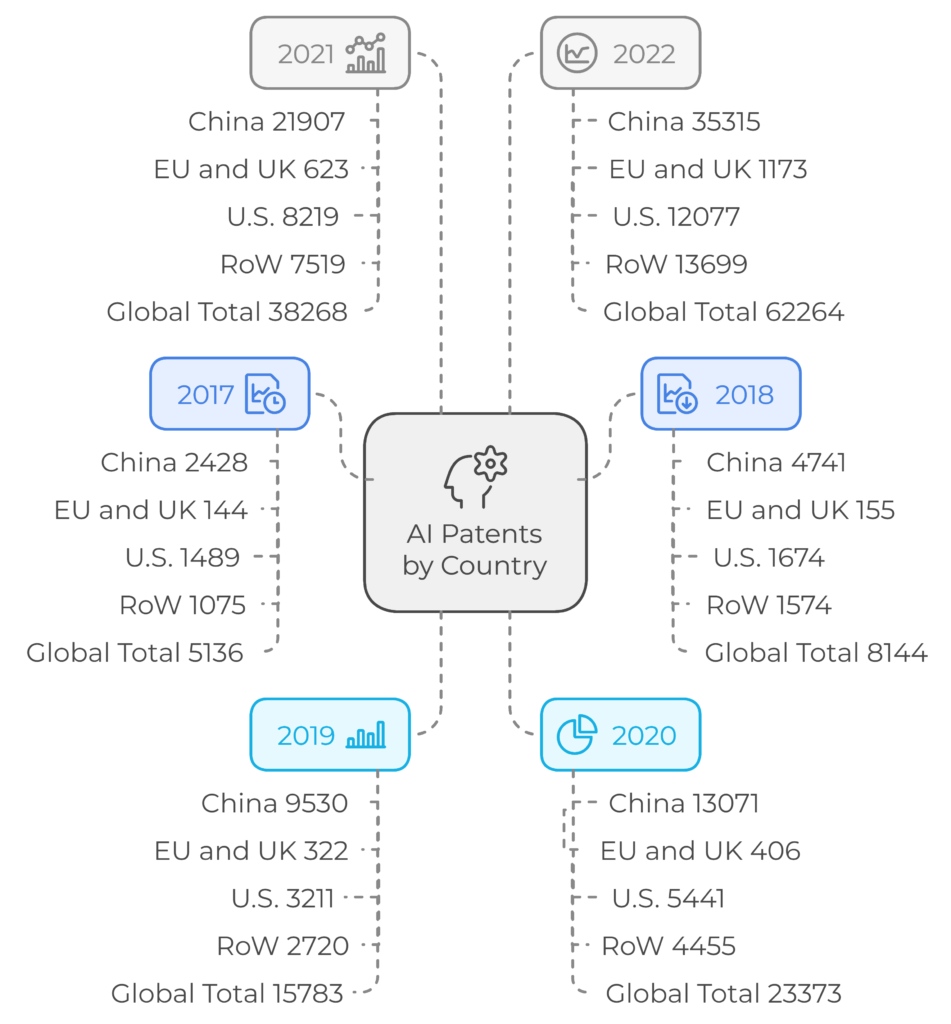
China dominates the AI Patents leaderboard throughout the 2017-2022, with around 35315 patents in 2022.
This is followed by the US which averages about a third of China’s output, with 12077 AI patents in 2022.
India Will Have 100 AI Unicorns in The Next Decade
According to SenseAI Ventures on LinkedIn, SenseAI’s Managing Partner Rahul Agarwalla predicts India will get at least 100 unicorns in the decade of 2024-2034.
China Is on a Par with or Ahead of the U.S. On Many Predictors of AI Performance
As per The Diplomat, China is a tech-savvy competitor that threatens the US’s monopoly in the field of AI.
There Are More than 2,300 AI startups Active in Israel Today
Israel is also known as the country with the highest number of startups per capita. (Google Blog, 2024)
The country also has major players such as Nvidia supporting their initiatives in the AI startup market:
Nvidia has collaborated with Israel for a project known as Israel-1, a supercomputer designated for research, government, and industry applications. (Google Blog, 2024)
Top Challenges Faced by Startups in Implementing AI
According to Oracle, here are some of the main challenges faced by AI startups:
- Data privacy and security: AI models could leak sensitive information that was used in its training data, which could also consist of names, addresses, etc
- Data volume: Large quantities of training data are required to provide an accurate output
- Computing power: Training AI models requires significant amounts of computing power, bigger projects require GPU clusters and large amounts of energy to train
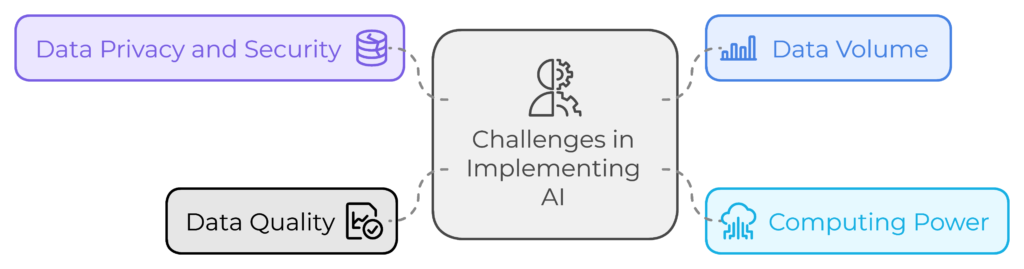
- Data quality: Noise and redundant information should be filtered from the data, as the saying goes: Garbage in, garbage out
AI Startup Case Study: A Deep Dive into Anthropic’s Journey
Anthropic was founded in 2021 by ex-OpenAI researcher Dario Amodei and his sister, Daniela Amodei.
According to the company’s mission statement:
“Anthropic is dedicated to building systems that people can rely on and generating research about the opportunities and risks of AI.”
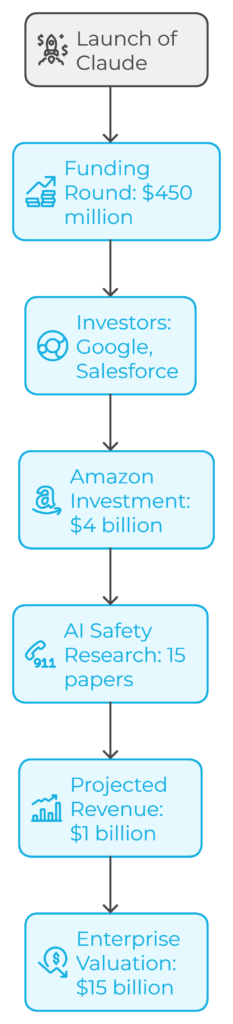
1. In May of 2023, Anthropic raised $450 million from investors including Google and Salesforce. (The New York Times, 2024)
2. Amazon has since invested $4 billion in Anthropic, for the goal of advancing generative AI. (Amazon, 2023)
3. Anthropic launched its first model, Claude, on Pi Day (14 March) in 2023.
4. Anthropic has also published over 15 AI safety research papers. (Anthropic, 2024)
5. Anthropic now has an enterprise valuation of $15 billion. (The New York Times, 2024)
6, Some people close to the company believe Anthropic could reach $1 billion in annualized revenue next year, which makes it a company to look out for. (The Information, 2023)
Final Thoughts on The Path Ahead for AI Startups
According to a podcast by Ycombinator, although a lot of buzz in the AI sphere is generated by interesting ideas such as multi-modal AI, many startups taking off right now haven’t needed to implement fancy technology.
These go for seemingly mundane yet highly efficient solutions such as streamlining workflow
and automating repetitive tasks.
Their advice to future AI startups would be to search for genuine use cases.

About the author
Editorial Staff
The Editorial Staff at Bot Memo is a team of writers, analysts, and AI agents dedicated to mapping the global AI startup ecosystem. Led by Chintan Zalani, the team tracks thousands of funding rounds, classifies companies across verticals, and distills it all into actionable intelligence for investors and founders.