

AI capabilities have only been increasing in the past years.
As an example, AlphaZero surpassed all accumulated human knowledge about Go after a day or so of self-play.
This brings out the question, will AI replace jobs in the future?
To shed some insight on this issue, you can read our report with statistics on AI’s impact on the job market.
On this page
- Key AI Replacing Jobs Statistics: Editor’s Choice
- What Percentage of Jobs Can Be Replaced By AI?
- How Do Workers Feel About AI?
- How Many Job Losses Due to AI?
- How Many Jobs Will Be Lost to AI By 2030?
- 68.3% Thought Good Outcomes From Superhuman AI Were More Likely Than Bad
- AI Adoption By Industry Statistics
- An AI System Generated 40,000 Potential Chemical Warfare Agents in a Few Hours
- Final Thoughts: Embracing AI
Key AI Replacing Jobs Statistics: Editor’s Choice
1. By 2030, up to 30% of employee hours worked in the U.S. could be automated.
2. The U.S. also added 818,000 fewer jobs than reported previously, which indicates a more fragile economy.
3. A quarter of workers are worried AI will make jobs obsolete.
4. 61% of large U.S. firms plan to use AI within the next year to automate repetitive tasks.
5. Nobel Prize-winning MIT economist doesn’t think automation will completely replace humans’ jobs.
What Percentage of Jobs Can Be Replaced By AI?
AI could automate 18% of work globally, leaving around 300 million full-time jobs exposed to automation, according to Goldman Sachs.
The report goes on to say that roughly two-thirds of the 900 occupations surveyed are currently exposed to some degree of automation.
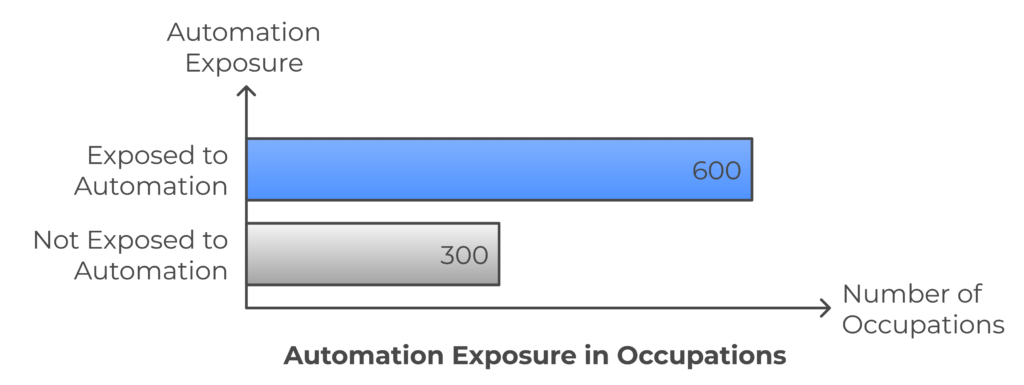
Yet, the authors add that AI is more likely to enhance these jobs and partially automate certain work related tasks, or even create jobs, instead of replacing them completely.
By 2030, Up to 30 Percent of Hours Currently Worked Across the US Economy Could Be Automated
By 2030, activities that account for up to 30 percent of hours currently worked across the US economy could be automated—a trend accelerated by generative AI. (Mckinsey, 2023)
U.S. Added 818,000 Fewer Jobs Than Reported Previously
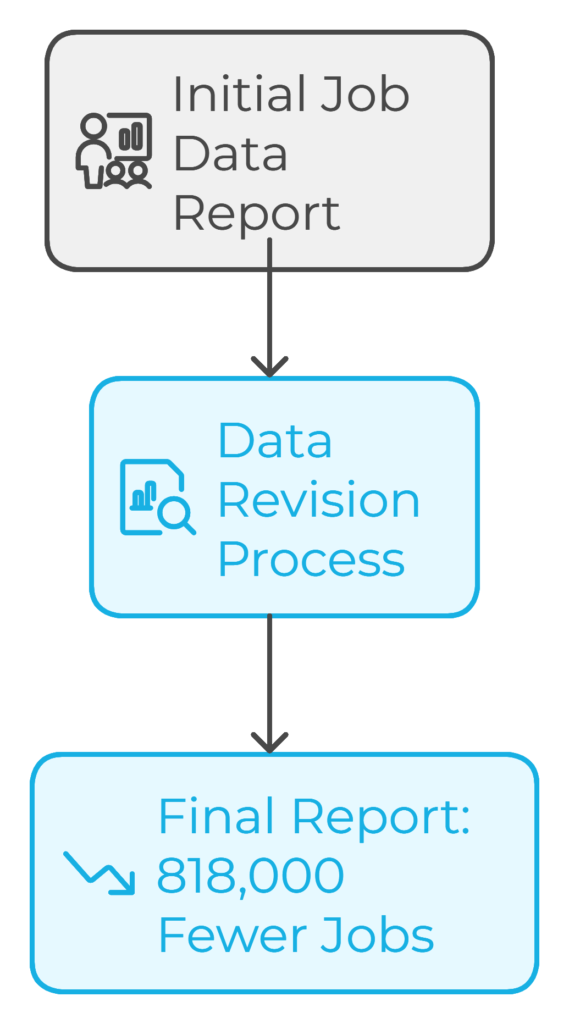
The U.S. Labor Department said that real jobs added in the past year were 818,000 less than those reported-corresponding to a downward revision of around 30%. (The New York Times, 2024)
This trend points to an economy that is less robust than previously expected.
61% of Large US Firms Plan to Use AI Within the Next Year to Automate Human Tasks
According to a recent survey of finance chiefs, 61% of large U.S. firms plan to automate tasks that were previously done by their employees, within the year.
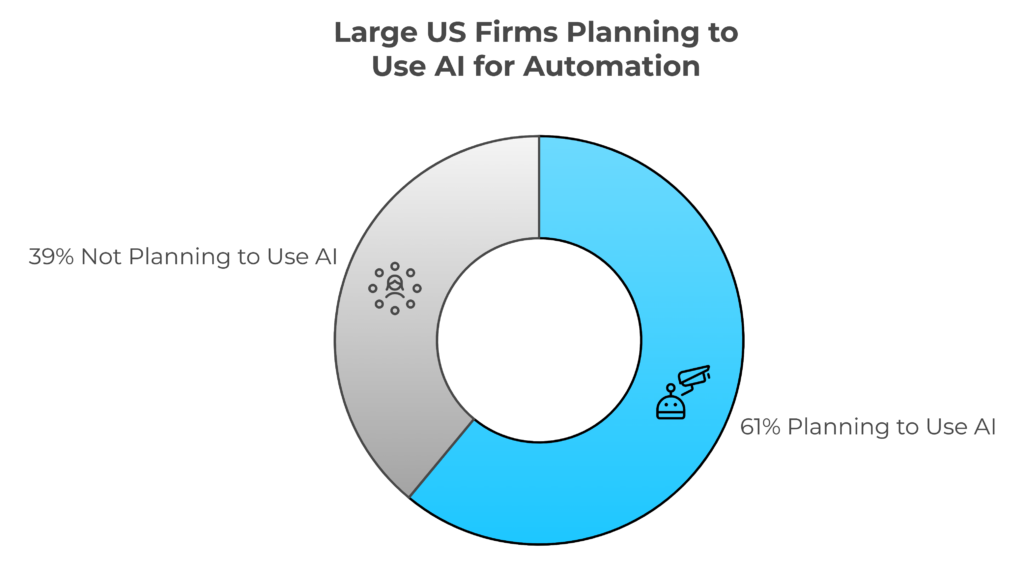
The key tasks described include paying suppliers, doing invoices, and financial reporting. (CNN, 2024)
When Accounting for Small Firms as Well, Nearly One in Three Plan to Use AI for Tasks Within The Year
John Graham, Professor of Finance from Duke University, gives his reasons on why AI adoption is necessary for firms.
“You can’t be running an innovative company without seriously considering these technologies. You run the risk of being left behind,” he says. (CNN, 2024)
In case the loss news is disheartening, according to a ResearchGate paper, 60% of the jobs today didn’t exist in the 1940s.
Additionally, the new jobs created could potentially mitigate job losses.
How Do Workers Feel About AI?
Workers aren’t overall too worried about AI replacing their jobs, but they feel uncomfortable with AI being used for tasks such as hiring.
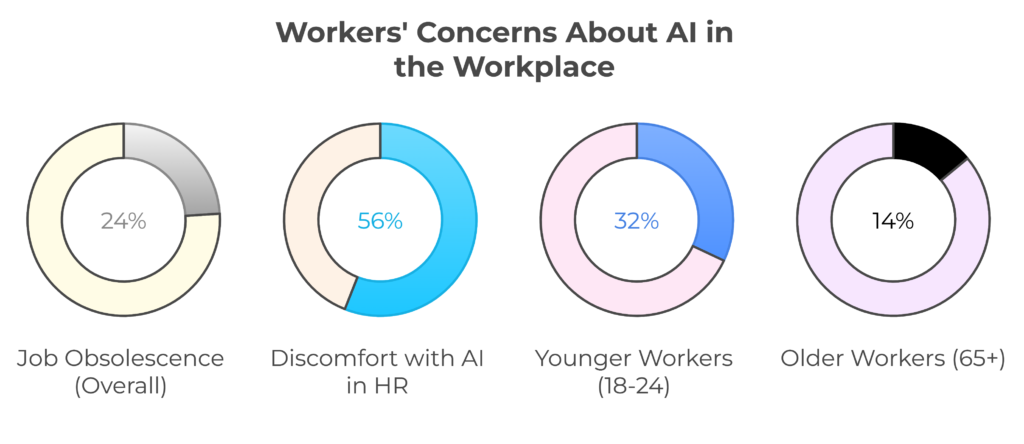
24% of Workers Fear That AI May Make Their Job Obsolete
Workers in minority categories such as lower-paid workers, people of color and younger workers were more concerned. (Survey Monkey, 2023)
56% of Workers Aren’t Comfortable With AI Being Used to Assist HR With Hiring
Other tasks they aren’t comfortable with AI doing are performance evaluations and operations. (Survey Monkey, 2023)
Older Workers Are Around Half as Worried as Younger Ones
32% of workers aged 18-24 are worried, while just 14% of those aged 65+ are. (Survey Monkey, 2023)
How Many Job Losses Due to AI?
It is hard to say exactly how many job losses will occur due to AI, but what is happening right now is that there have been millions of job shifts.
Along with that, a third of automation is being used to substitute human workers.
33% of Automation Is Used to Substitute Workers
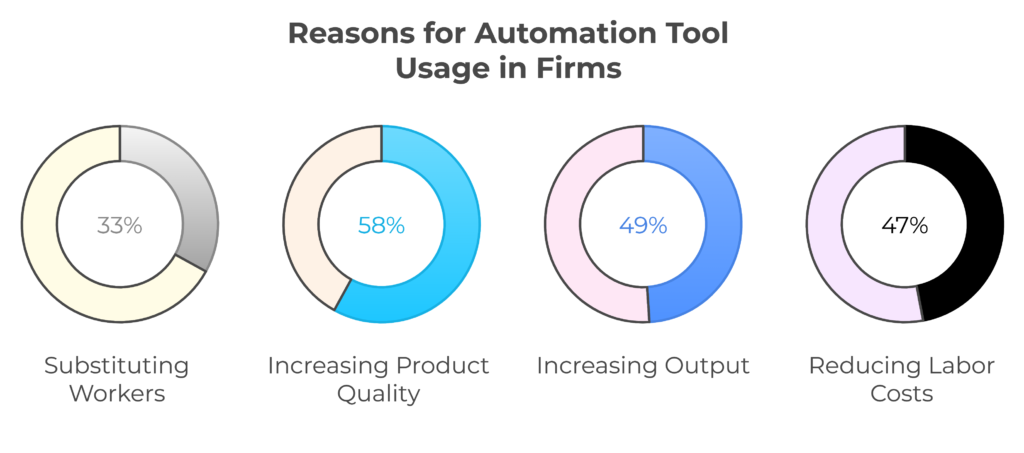
Other reasons for the use of these automation tools was to to increase product quality (58% of firms).increase output (49%), and to reduce labor costs (47%). (CNN, 2024)
Let’s look at a Mckinsey report on how professionals like STEM are dealing with AI.
Generative AI Is Likely to Enhance the Way STEM, Creative, Business, and Legal Professionals Work
Jobs in STEM, creative fields, business and legal professions are more likely to be enhanced by Gen AI instead of being outright replaced.
In fact, the labor demand for STEM jobs could increase in the future, showing promise for future careers in the field.
By 2030, McKinsey Estimates a 23 Percent Increase in the Demand for STEM Jobs
Despite the current trend of layoffs in 2024, long-term projections for STEM fields looked quite promising.
During the Pandemic Period (2019-2022), the US Labor Market Saw 8.6 Million Occupational Shift
Food services, offline sales people and office support workers were the most affected.
How Many Jobs Will Be Lost to AI By 2030?
Some estimates predict jobs being either repurposed or replaced completely, around the figure of tens of millions.
An Additional 12 Million Occupational Transitions May Be Needed by 2030
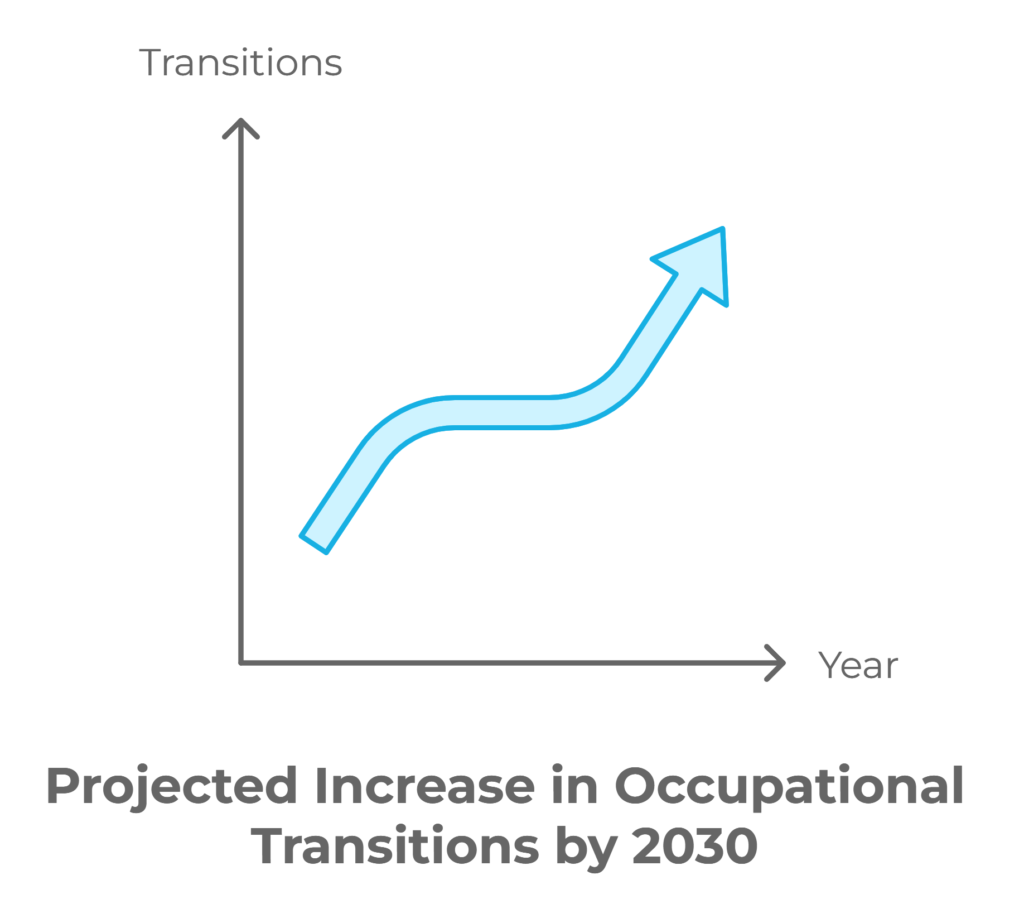
This figure is around 25% higher than the one predicted two years ago by a different report by McKinsey. (McKinsey, 2023)
Industrial robots are already being tested to see how many factory workers’ shifts they can perform in their shift, right now they can do 3.3x human labor.
One Robot Replaces 3.3 Jobs in the U.S.
In a study documenting the effects of robots on employment, MIT Professor Daron Acemoglu found that each robot could replace 3 human jobs. (MIT, 2020)
Despite job worries, Superhuman AI is still mostly looked at as a boon rather than a bane.
68.3% Thought Good Outcomes From Superhuman AI Were More Likely Than Bad
In a unique Arxiv survey, 2778 researchers at the forefront of Artificial Intelligence were asked about their future predictions.
Most (68.3%) were optimistic about future outcomes from Superhuman AI.
The Chance of Jobs Becoming Fully Automatable Was Forecast to Reach 10% by 2037 and 50% by 2116
Previously, in the survey done two years before, it was predicted that 50% of jobs would be automated by 2116.
This shows that predictions for future high-level benchmarks are getting closer.
The 2023 Forecast Predicted a 50% Chance of HLMI by 2047, Down Thirteen Years From 2060
HLMI stands for High Level Machine Intelligence, a benchmark that is achieved when machines can do every task in a better, more cost-effective manner than humans can.
HLMI was previously predicted to have a 50% chance by 2060, but now that has been revised to 2047.
Nobel Prize-Winning MIT Economist Doesn’t Think Automation Will Replace Jobs
Robert Solow, an MIT economist who received the 1987 Nobel Prize for explaining the role of technology in economic growth, isn’t worried about automation.
In his piece, titled “Problems That Don’t Worry Me,” Solow scoffed at the idea that automation was leading to mass unemployment.
AI Adoption By Industry Statistics
According to Statista, here is the distribution of AI adoption across industries:
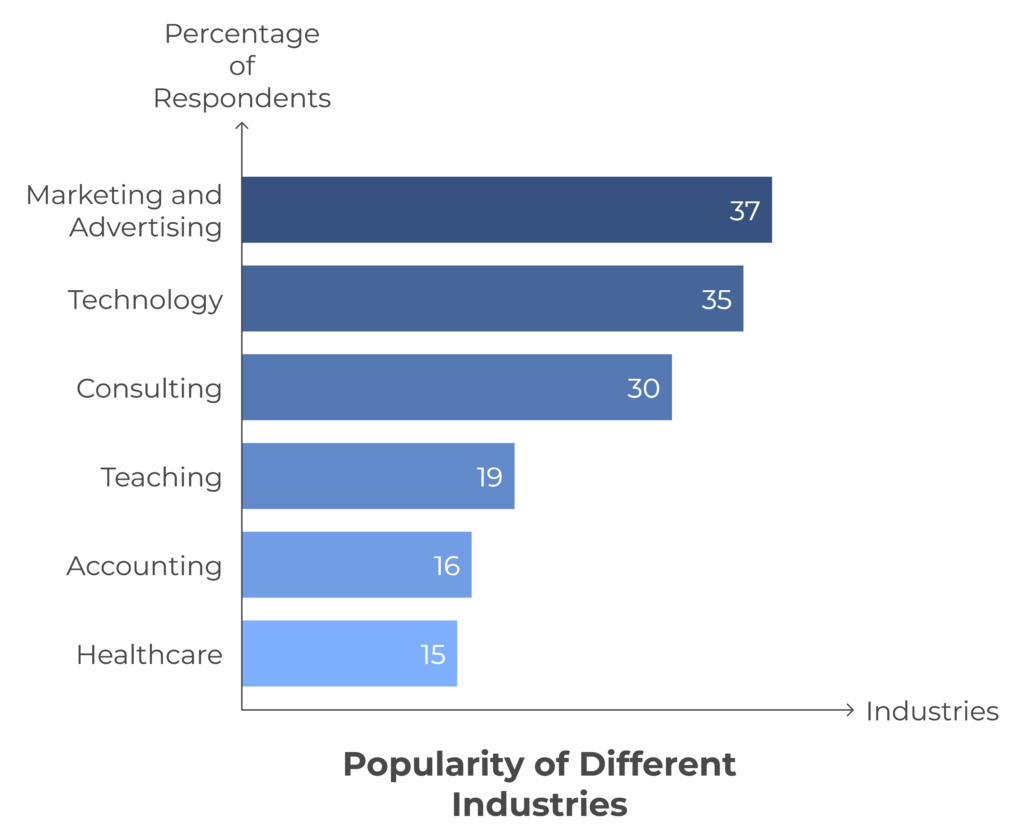
- Marketing and advertising: 37%
- Technology: 35%
- Consulting: 35%
- Teaching: 19%
- Accounting: 16%
- Healthcare: 15%
35% Cited Financial or Cost Savings as the Main Reason for Using AI Technologies
According to a survey by the UK Government, here are some more stats on why companies adopted AI technology:
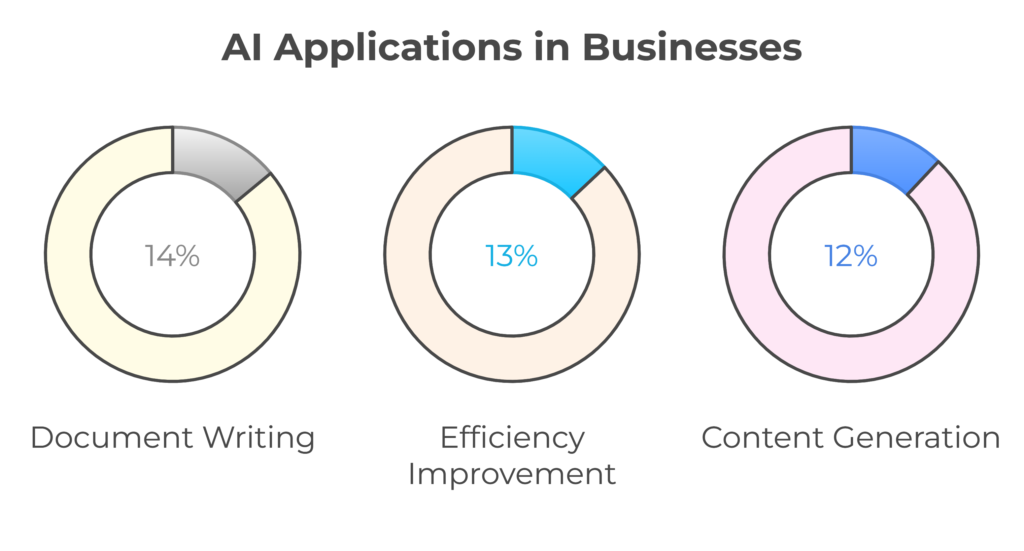
- 14% of businesses used AI to help write documents
- 13% employed AI for better efficiency
- 12% used AI for content generation
By what means can organizations adopt AI?
38% to 60% Adopted AI Technologies Through Ready-to-Use Systems or by Buying External Software
ML technologies can be created within the company itself.
Around one in five businesses developed machine learning (21%) and hardware related to AI (19%) in-house.
Which Jobs Are in Danger Due to AI?
Jobs such as Office support, customer service, and food service employment are more likely to be in danger because of AI. (Mckinsey, 2023)
The situation for data entry jobs is quite dire as well:
Around 8 Million Data Entry Jobs Are Expected to Be Lost by 2027
Other jobs that are in danger are secretarial jobs or those that require clerical activity, such as bank tellers and data entry jobs. (WEF, 2023)
What Jobs Are Future Proof From AI?
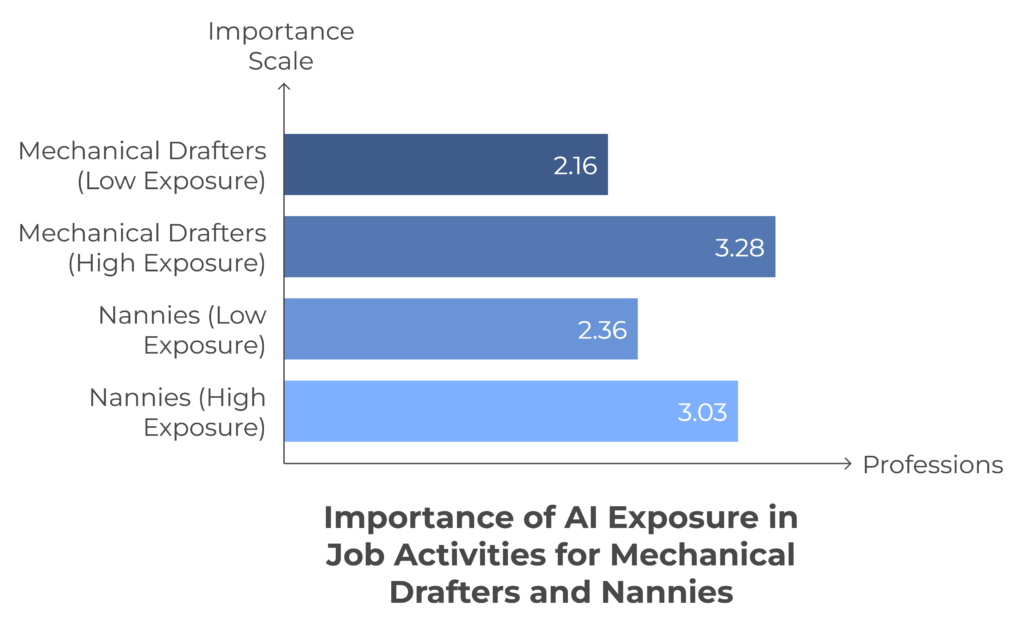
The jobs more likely to have less exposure to AI are those that involve more interpersonal interaction such as nannies, teaching, relationship building, etc.
Those in the information sector aren’t threatened by AI as much either, saying that it would be a boon rather than a bane to them.
32% of Workers in Information and Technology Say AI Will Help More Than Hurt Them Personally
Only 11% in this sector say that AI will negatively impact them more than it’ll help. (Pew Research, 2023)
According to Pew Research, Nannies and Mechanical Drafters Had the Least Exposure to AI
Other such jobs included jobs in the performing arts, coaching and teaching others, and those that involved interpersonal skills such as relationship/team building. (Pew Research, 2023)
An AI System Generated 40,000 Potential Chemical Warfare Agents in a Few Hours
Researchers reworked an AI system that was previously used for medical purposes to see if it could generate toxic molecules.
They managed to create more than 40,000 potentially hazardous chemicals.
So there seem to be risks within our existing AI systems already, and so caution should be taken to mitigate those risks.
According to the The New York Times, an Open Letter was sent from the Centre for AI Safety, which said:
“Mitigating the risk of extinction from AI should be a global priority alongside other societal-scale risks, such as pandemics and nuclear war,”
Only 400 People Were Working in AI Safety in 2022
Although the number has likely grown since it is still an important issue that more people should take note of. (80,000 hours, 2022)
Some Experts on AI Risk Think That the Odds of X-Risk Are as Low as 0.5%, While Others Think That It’s Higher Than 50%
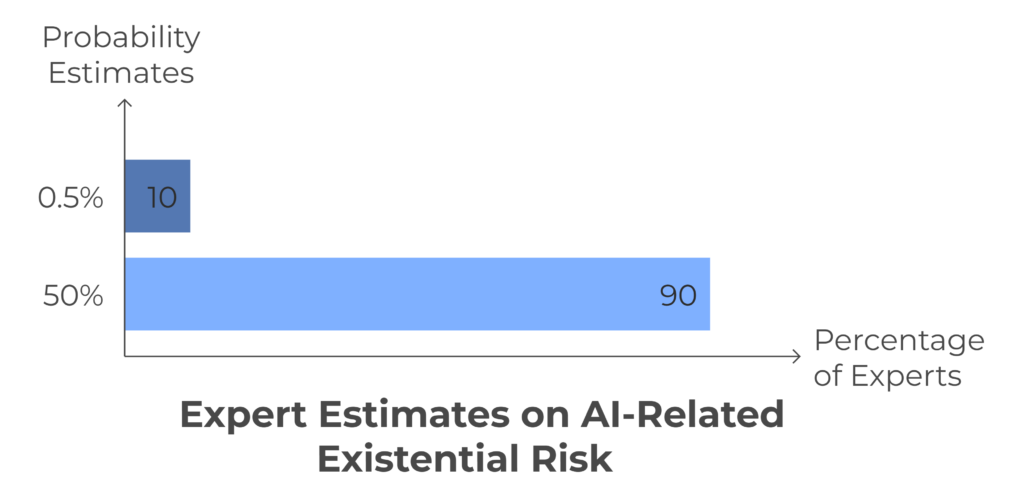
X-Risk stands for existential risks due to AI.
There are various estimates for this risk, 80,000 Hours puts the risk at around 3% to 50%. (80,000 hours, 2022)
Final Thoughts: Embracing AI
In an 2023 interview with the UK prime minister, Rishi Sunak, Elon Musk declared there will come a time when “no job is needed,” thanks to an AI “magic genie that can do everything you want.”
While this might seem a bit too convenient, AI integration in the future will demonstrably make achieving milestones easier.

About the author
Editorial Staff
The Editorial Staff at Bot Memo is a team of writers, analysts, and AI agents dedicated to mapping the global AI startup ecosystem. Led by Chintan Zalani, the team tracks thousands of funding rounds, classifies companies across verticals, and distills it all into actionable intelligence for investors and founders.