
AI already has widespread adoption among marketers with nearly 3 out of 4 using AI tools. (Botco.AI, 2023)
It can help automate mundane tasks like email marketing, and help marketers focus on strategy and creativity.
Let’s look at the myriad ways in which AI is impacting the marketing industry in 2024.
On this page
Key AI Marketing Stats: Editor’s Choice
1. Nearly 3 out of 4 marketers are using AI tools.
2. Of the companies that use GenAI, 66% have received a positive ROI, with 43% saying they experience a 2x ROI and 22% saying they’ve received a 3x ROI.
3. Around 66% of people think AI writing is similar, or even better, quality to human writing.
4. Only 7% of respondents report seeing a negative ROI thus far.
5. 71% of marketers claimed AI was effective in helping their campaigns, while only 2% said their efforts were ineffective.
6. 88% of marketers find that AI or ML software saves their company time and money.
Rate of Gen AI Adoption in Marketing
During a 2023 survey conducted among professionals in the United States, it was found that marketers had the highest Gen AI usage.
1. 37% of advertising employees used AI to assist with work-related tasks. (Statista, 2023)
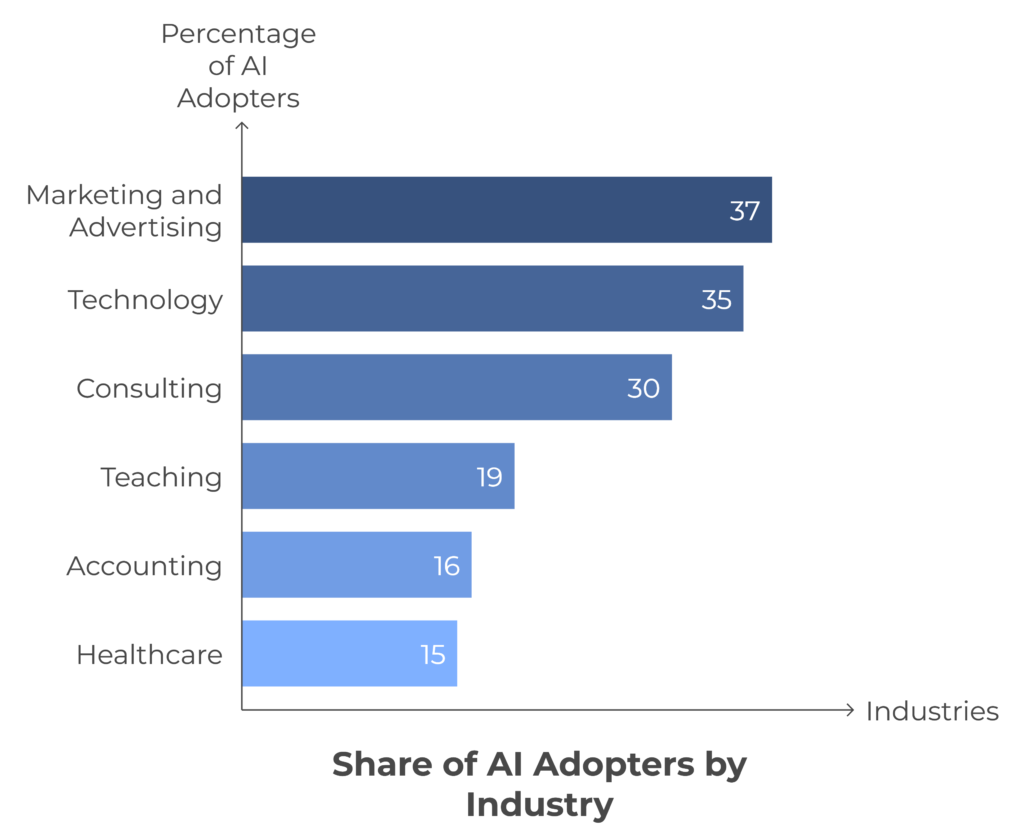
Marketing and advertising had the highest AI usage at 37%, while healthcare had the lowest at 15%.
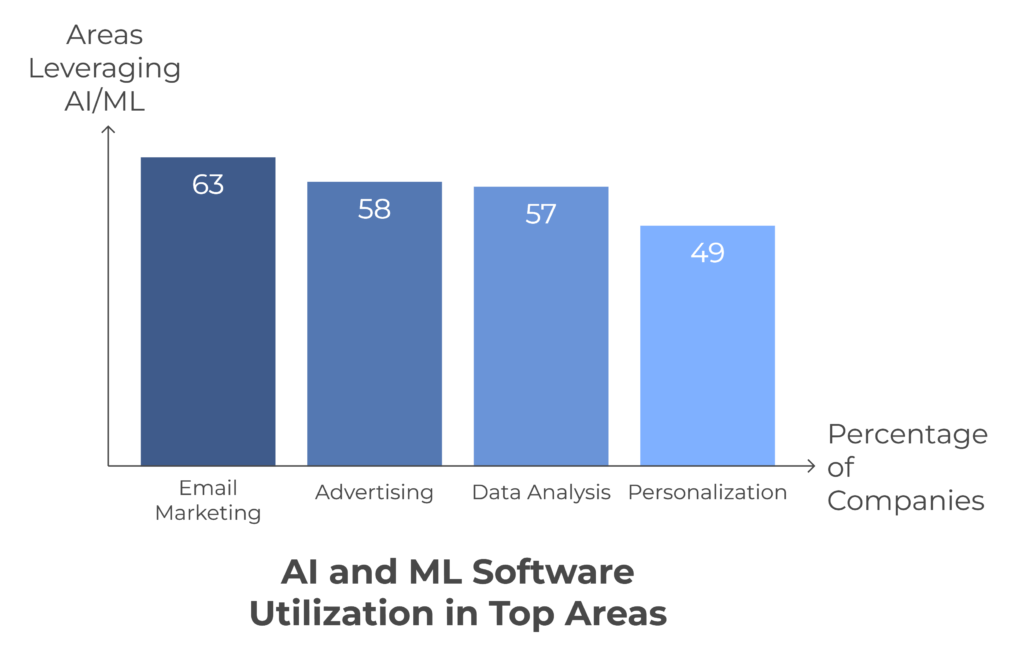
2. Companies leveraged machine learning tools primarily in email marketing, advertising, and data analysis. (Capterra, 2022)
How are marketers personally using AI?
3. 69% of marketers are using ChatGPT. (Authority Hacker, 2024)
3. 98.1% of marketers acknowledge that some understanding of AI is important for their job. (Authority Hacker, 2024)
Inaccuracies seem to be the major challenge for AI implementation thus far.
4.63% of AI adopters cite inaccuracies in AI content as a major challenge. (Authority Hacker, 2024)
Implementation is also time-costly with around 69% of companies taking six months or more.
7. The majority of marketers (69%) admit that it took their company six months or longer. (Capterra, 2022)
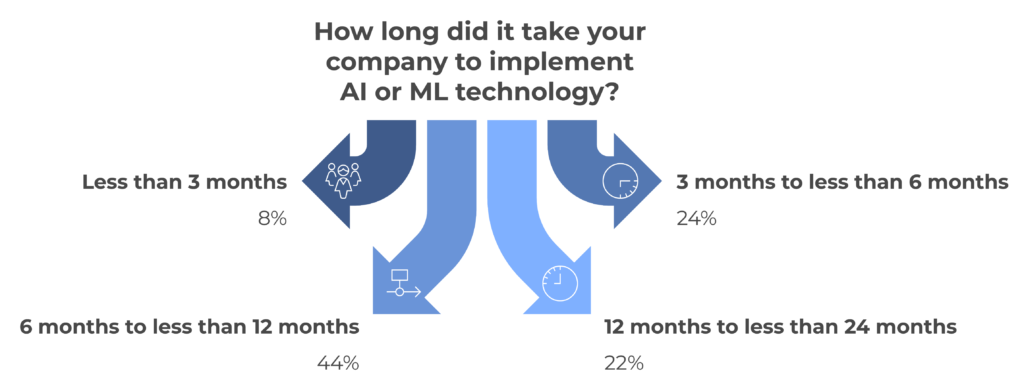
Very few marketers report that AI adoption was ineffective in their marketing campaigns.
8. 71% of marketers claimed AI was effective in helping their campaigns, while only 2% said their efforts were ineffective. (Semrush, 2024)
9. 88% of marketers find that AI or ML software saves their company time and money. (Capterra, 2022)
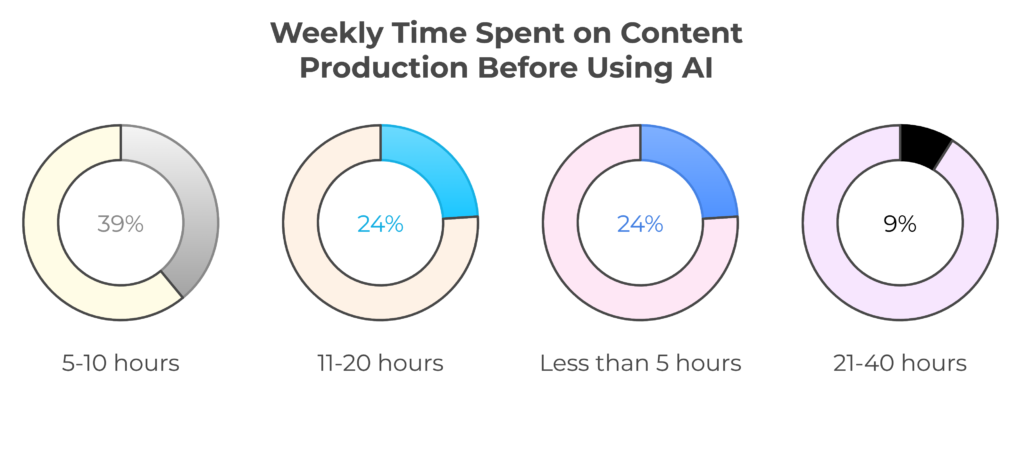
This graphic shows the distribution of time spent creating content before AI.
11. Of the companies that use GenAI, 66% have received a positive ROI, with 43% saying they experience a 2x ROI and 22% saying they’ve received a 3x ROI. (Botco.AI, 2023)
12. Only 7% of respondents report seeing a negative ROI thus far. (Botco.AI, 2023)
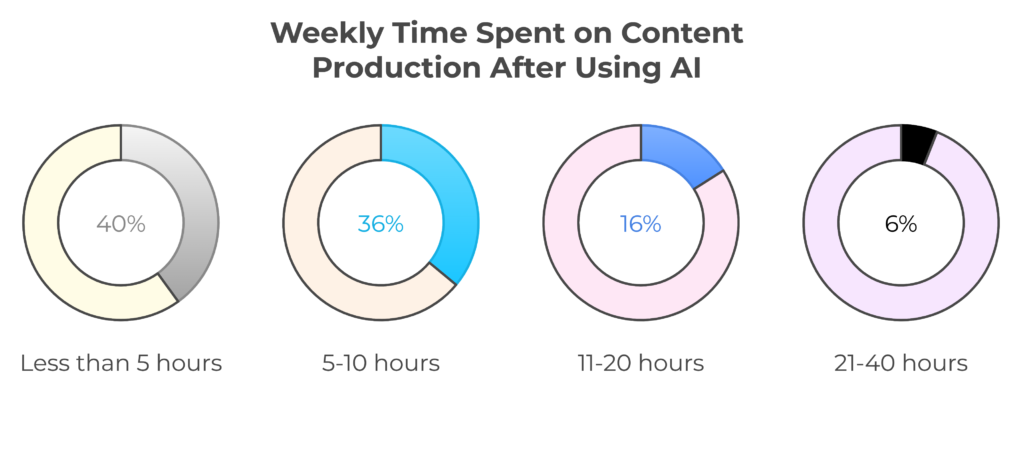
This graphic shows a marked difference in the distribution of time spent creating content with the help of AI.
13. The percentage of AI-written content being fact-checked is extremely low at 11.9%. (Authority Hacker, 2024)
This is concerning for the future quality of content creation.
How Do Marketers Themselves Feel About AI?
Around 68% of marketers have said that AI helped them grow their careers, according to Authority Hacker.
Lack of knowledge(45%) is the biggest factor that impedes AI adoption, according to the survey by Authority Hacker.
Lack of time for proper testing comes second at 22.5%.
How Do Marketers Use AI?
Marketers broadly use AI to generate ideas, create outlines and images, and write copy.
In 2018, McKinsey Found 400 Advanced Use Cases of AI in Marketing
According to insights from McKinsey, the value of AI is not to be found in the models themselves, but in companies’ abilities to harness them.
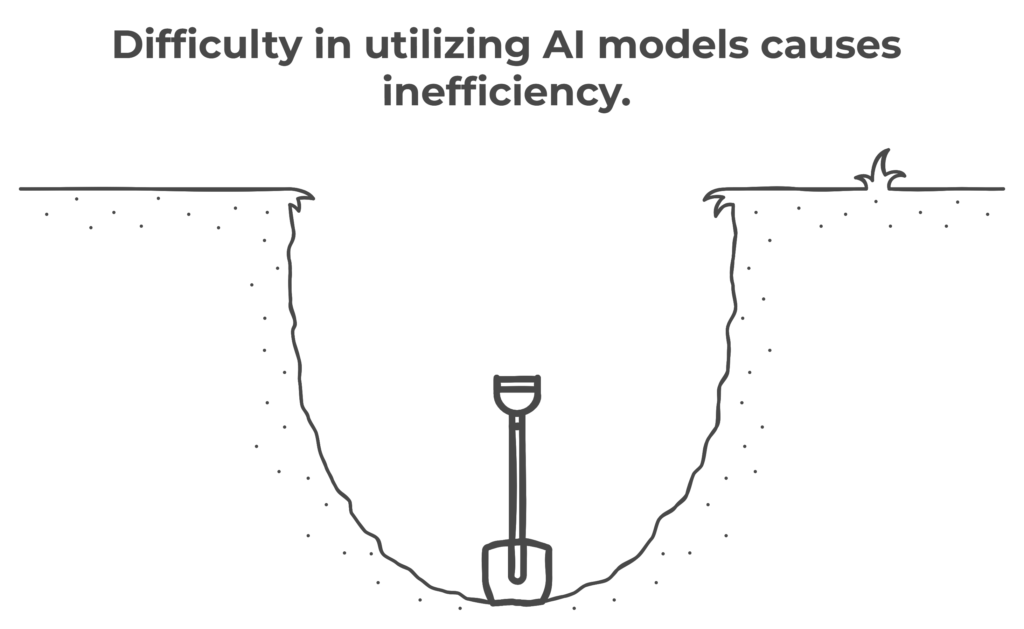
- It has been found that the more complex the model used, the more likelihood it has to be used in AI applications.
- Two-thirds of the opportunities to use AI are to enhance the performance of existing methods.
- AI can be a valuable tool for customer service management and personalized marketing.
- Ongoing data acquisition for retraining AI systems is necessary; one out of three use cases requires model refreshes at least monthly and sometimes daily.
AI techniques could potentially increase value above and beyond traditional analytics techniques ranging from 30 percent to 128 percent, depending on the specific industry.
Realizing AI’s full potential requires multimodal data (images, video, audio, etc).
AI in Content and Social Media Marketing
The most common use cases are idea generation, summarization, writing copy, and creating images and outlines, according to a survey by HubSpot.
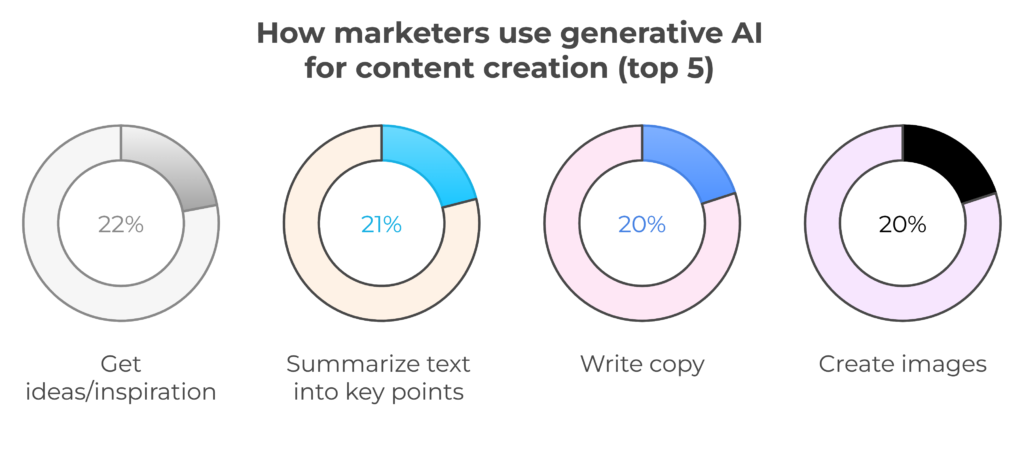
AI can also help marketers in day-to-day tasks and creating quality, personalized content, as we’ll see below.
1. Day-to-Day Marketing Tasks
Marketers use chatbots to smoothen interactions with customers.
36% of marketers use AI chatbots in their marketing role and a further 58% plan on increasing their investments in AI.
2. Personalized Experiences
72% of marketers agree that AI and automation tools like chatbots help them personalize the experience customers get with their company.
3. Customer Service and Growth
24% of marketers say AI tools help customer service teams respond to tickets (chatbots, self-service tools, generative AI emails) would help their business the most.
4. AI Quality
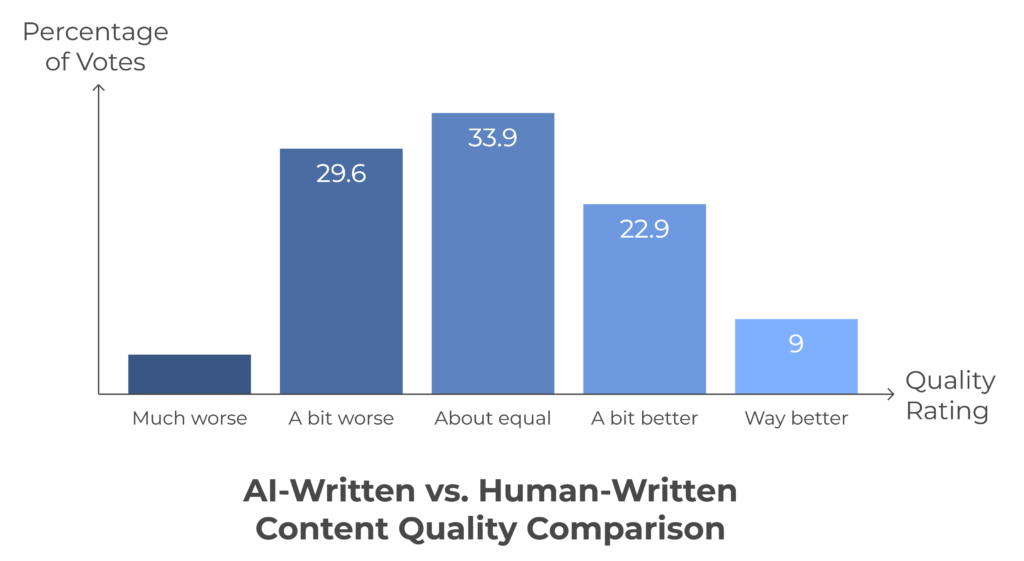
- 82% of marketers say content generated by AI or ML software is just as good (or even better!) than human-generated content. (Capterra, 2022)
- Almost half (49%) of marketers say AI or ML software is very successful at producing legible content. However, they regarded it as faulty when it comes to providing accurate content free of hallucinations. (Capterra, 2022)
- Around 66% of people think AI writing is similar, or even better, quality to human writing. (Authority Hacker, 2024)
AI’s Role in Influencer Marketing
The global influencer market has soared in previous years, tripling its market share since 2019.
1. The global influencer marketing market size has more than tripled since 2019. In 2024, the market was estimated to reach a record of 24 billion U.S. dollars. (Statista, 2024)
Virtual influencers created by AI are also a part of this market.
2. Let’s take a look at a report from Grand View Research on virtual influencers.
- The global virtual influencer market size was estimated at $3.60 billion in 2022
- It is projected to grow at a compound annual growth rate of 38.9% from 2023 to 2030
- The solution segment held the largest market share of over 69%, which deals with the process of integrating virtual influencers into marketing strategies
- The services segment is expected to grow the fastest from 2023 to 2030, across the verticals of consultancy, analytics, and reporting
- The North American region witnessed the largest market share of over 44% in 2022
3. Marketing agencies are brands are planning to capitalize on ML tools for influencer marketing, according to Statista:
- 63% of marketing agencies and brands stated that they were going to use ML tools for influencer marketing in the upcoming year.
Virtual influencers also have a significant impact on consumers deciding what to buy.
- 35% of consumers said they had purchased a product or service promoted by a virtual influencer, while the rest said they had not done so.
- 45% of respondents aged between 35-44 said they had bought a product or service promoted by a virtual influencer.
How Do Consumers Feel About AI Influencers?
According to the New York Post, 37% of respondents said AI influencers would actually make them more interested.
- Another 37% of respondents said they wouldn’t trust the brand after that.
- The rest of the respondents didn’t care about the issue.
- 49% of social media influencers were worried that AI influencers would take their jobs. (New York Post., 2024)
Consumer Concerns Around AI
What are the major concerns consumers have when it comes to AI?
How Do Consumers Feel About AI Generated Content?
Although there is widespread acceptance that AI-generated content will be present in the future, there are mixed feelings on whether this is a good thing.
There isn’t much interest garnered by consumers on learning about generative AI tools, from astudy by Dentsu.
- 78% of consumers polled believe generative AI is the future — but only 39% are excited about that future.
- Another 78% of consumers want brands to be transparent when they’re using AI.
- Only 42% report being interested in generative AI tools, and only 27% have used them.
How do consumers feel when shown AI content?
Here’s a graphic from a survey by Bynder that illustrates the major points:
1. 56% percent of consumers found AI-generated content more engaging than human-generated content, and vice-versa for the remaining 44%.
However, when people knew the content was generated by AI, interest waned.
2. When customers knew that the content is AI-generated though, 52% felt less engaged.
3. Millennials, or the age group of 25-34-year-olds, were the best at spotting AI content.
4. Two-thirds preferred to know whether the content was AI-generated or not.
Here are some valuable insights by Forbes, on concerns consumers have with AI.
76% of Consumers Are Concerned With Misinformation From Artificial Intelligence (AI) Tools
76% of respondents are concerned about AI causing misinformation on a business’s website. The breakdown was 43% being very concerned and 33% somewhat concerned.
14% remain neutral, while the rest (10%) are completely indifferent.
Types of Content Where Consumers Are Concerned With AI Usage
Consumers are mostly concerned with AI being used maliciously in product descriptions, product reviews, and job applications.
How Do Organizations Feel About AI?
Organizations are rapidly adopting AI, with usage increasing from 55% in 2023 to 72% in 2024.
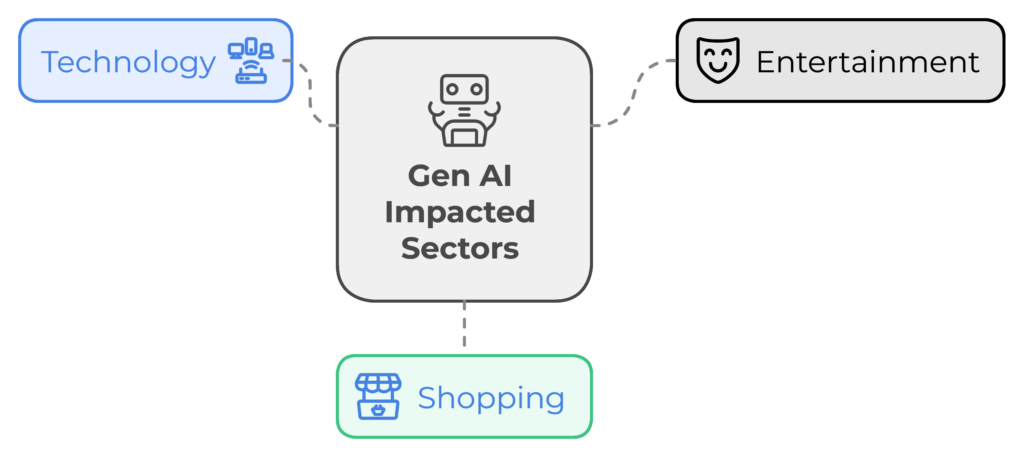
The top sectors impacted by Gen AI, with the Technology, Entertainment, and Shopping industries.
1. AI adoption surges worldwide, with the percentage of organizations adopting AI rising from 55% in 2023 to 72% in 2024. (Mckinsey, 2024)
2. Respondents are much more likely now than in 2023 to say they are using generative AI. (Mckinsey, 2024)
3. The number one consideration for 42% of marketers is that AI content isn’t original. (Semrush, 2024)
4. Here are the top sectors impacted by Gen AI, with the Technology, Entertainment and Shopping industries leading the charts. (Mntn Research, 2023)
Let’s look at AI adoption in organizations:
5. Companies are piloting or deploying AI (57%), have an AI strategy (59%), and understand how AI can generate business value (70%). (MIT Sloan, 2020)
6. Despite this, only 10% of companies obtain significant financial benefits from artificial intelligence technologies. (MIT Sloan, 2020)
7. The companies that successfully benefit from AI focus on organizational learning, not just machine learning. They value mutual reinforcement learning between humans and AI. (MIT Sloan, 2020)
8. 44% of business leaders said that their companies are planning to implement efforts to make data actionable and usable in 2024 to take better advantage of GenAI. (PWC, 2024)
Misinformation is one of the biggest risks to organizations adopting AI.
9. Around 30% of respondents considered that generative AI poses significant risks to brand safety and misinformation. For 55% it represents only a moderate risk to a brand’s reputation. (Statista, 2024)
10. Implementing AI tools into an organization’s workflow requires time, with more than 69% of companies taking 6 months or more to do so. (Capterra, 2022)
11. Adopting AI has costs but the price may be worth it, as only 8% of marketers use the free version. (Capterra, 2022)
Final Thoughts on The Future of AI in Marketing
In the future, around 68% of marketers said that they are going to invest in AI tools for marketing and SEO. (Semrush, 2024)
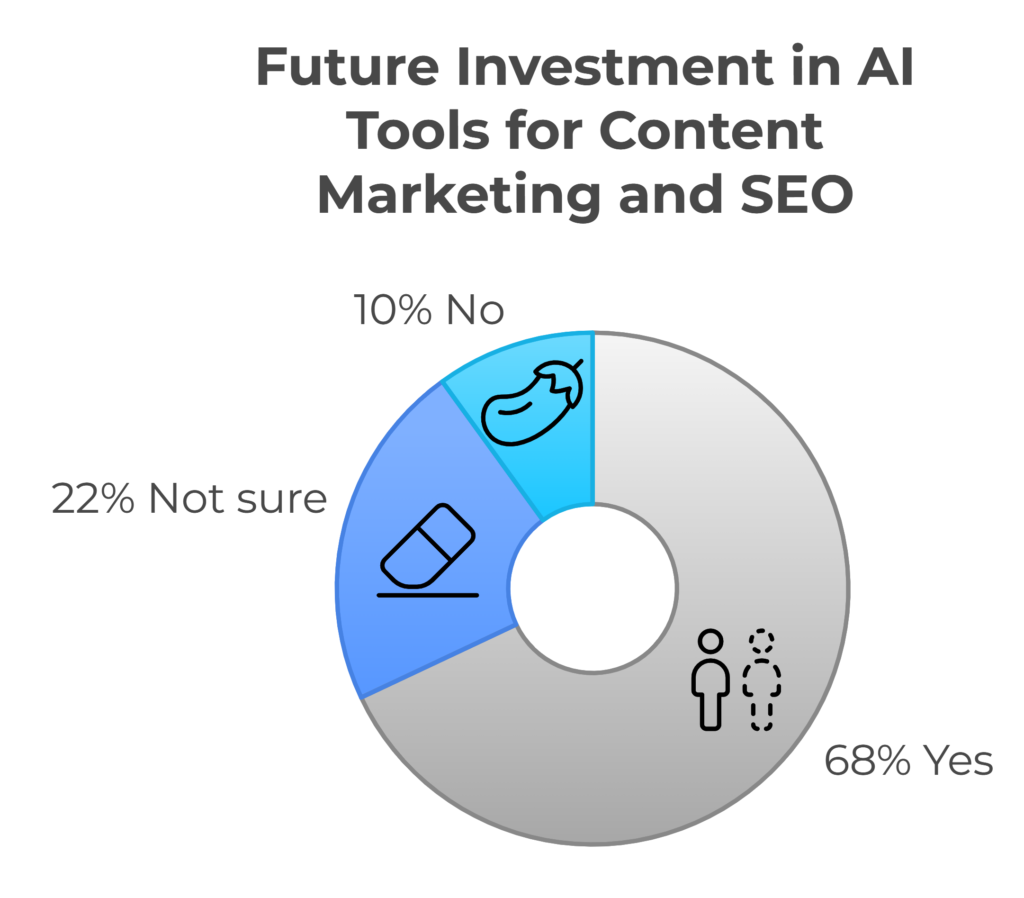
In the future, businesses are also willing to try out specialized AI tools like those that offer SEO data and optimize content creation. (Semrush, 2024)
There’s still a looming threat of jobs being replaced by AI though.
81.6% of marketers think content writers’ jobs are at risk because of AI. (Authority Hacker, 2024)

About the author
Editorial Staff
The Editorial Staff at Bot Memo is a team of writers, analysts, and AI agents dedicated to mapping the global AI startup ecosystem. Led by Chintan Zalani, the team tracks thousands of funding rounds, classifies companies across verticals, and distills it all into actionable intelligence for investors and founders.