
Artificial Intelligence is leaving its mark on the filmmaking industry as well.
AI rotoscoping from Runway was used on the 2022 film Everything Everywhere All at Once, which won multiple Academy Awards, including Best Picture. The VFX team used it to clean up one climactic scene, not to generate the film. (Variety, 2023)
Let’s dive into more such statistics on AI in filmmaking.
On this page
- How is AI Used in Filmmaking?
- Key AI Filmmaking Stats: Editor’s Choice
- Generative AI in Movies: Market Analysis Across Regions
- Have Any Films Been Written By AI?
- How Can AI Be Used in the Media and Entertainment Industry?
- 22% of People Believe Gen AI Can Write TV Shows And Movies More Interesting Than Humans
- Stats Around Usage of AI in Predicting Film Success
- Final Thoughts
How is AI Used in Filmmaking?
AI is already being used in a multitude of tasks in the movie industry.
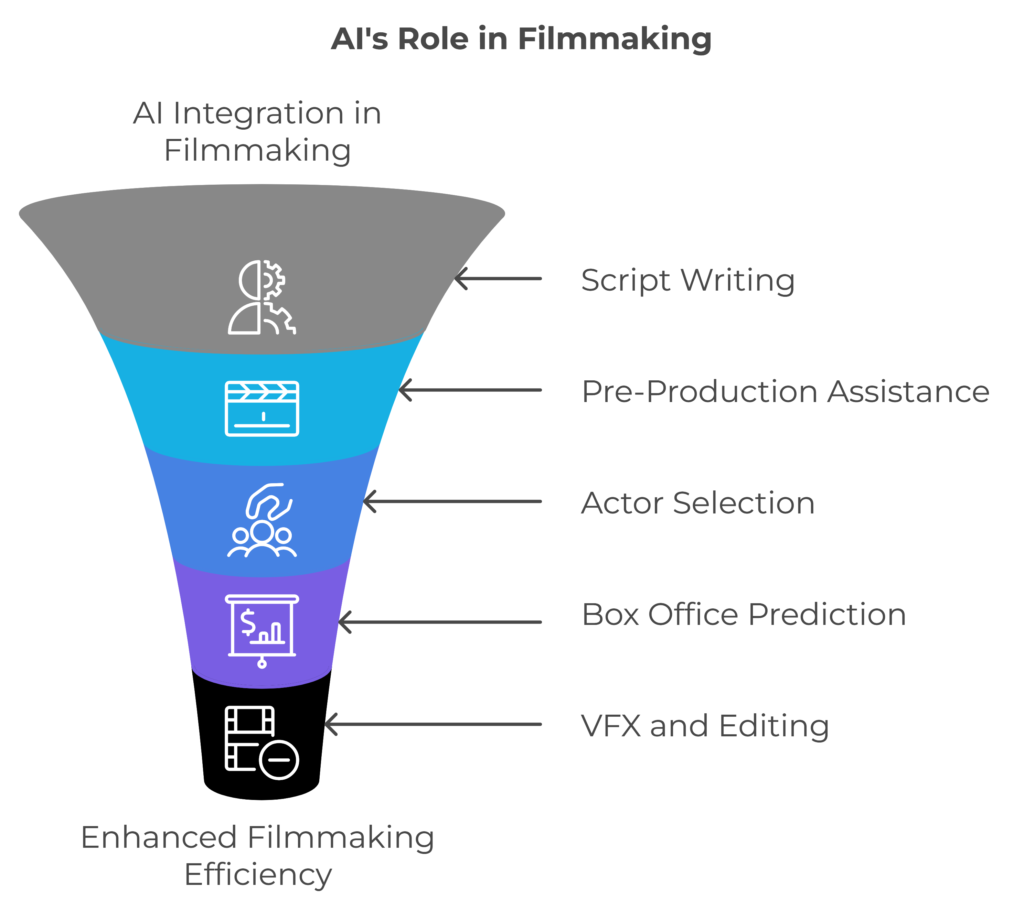
- Writing Scripts
- Assisting with Pre-Production and Post-Production
- Selecting Actors
- Predicting Box Office success
- VFX and Video Editing
Key AI Filmmaking Stats: Editor’s Choice
1. Global Generative AI in the Movies Market is expected to hit $4,490.7 Million by 2033 (28.2% CAGR).
2. 22% of people believe that AI can write TV shows and movies that are more interesting than those written by humans.
3. AI is already at work in film VFX. One example is Everything Everywhere All at Once, where Runway AI rotoscoping cleaned up a climactic scene.
4. Actors went on strike for 118 days in 2023 for fair compensation, residual increases, and protections around artificial intelligence.
5. Netflix CEO Ted Sarandos states AI can mimic elements of film, but can’t replicate authentic human experience.
Generative AI in Movies: Market Analysis Across Regions
1. Global Generative AI in the Movies Market is expected to hit $4,490.7 Million by 2033 (28.2% CAGR). (Dimension Market Research, 2024)
2. Content generation is the top use case for this forecast period. (Dimension Market Research, 2024)
3. North America is expected to hold a 46.8% share of revenue in the Global Generative AI in Movies Market. (Dimension Market Research, 2024)
Generative AI Use-Cases in the Global Entertainment Industry
AI is revolutionizing film by enhancing VFX, story development and editing, with generative AI enabling the creation of visually stunning movies.
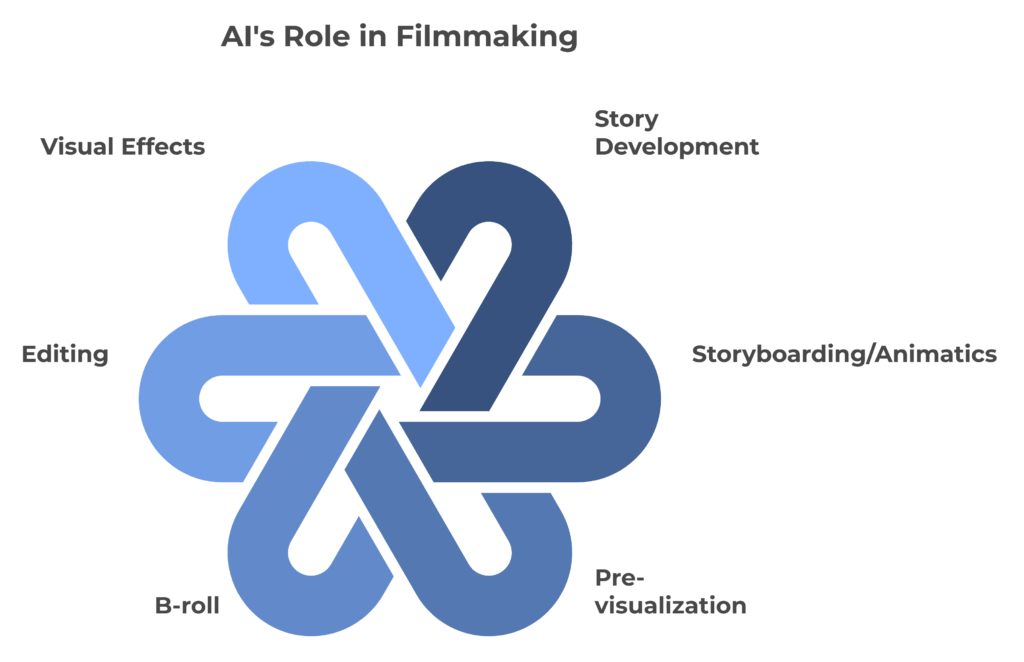
1. Use cases of AI systems in filmmaking include story development, storyboarding/animatics, pre-visualization (or “previs”), B-roll, editing, visual effects (VFX), and localization services. (Doug Shapiro, 2023)
2. Generative AI provides a lot of opportunities for crafting visually stunning and immersive films that exceed conventional imagination. (Dimension Market Research, 2024)
One example is Everything Everywhere All at Once, where the VFX team used Runway AI rotoscoping to clean up a climactic scene. (Variety, 2023)
3. Current paths in generative models, like neural networks and deep learning, empower filmmakers to create lifelike CGI characters and immersive settings. (Dimension Market Research, 2024)
The Distinction Between AI-Generated and Human-Generated Content Is Getting Harder To Accurately Determine
4. In a survey taken by Variety, Open AI’s Sora-generated video was mistaken as real footage. ( Variety, 2024)
How Far Can the Rise of AI in the Film Industry Go?
5. The prevalence of Gen AI in the production process will be gated by consumer acceptance, not technology. (Doug Shapiro, 2023)
Even so, there are predictions that an almost fully AI-generated very successful film will be produced by 2030.
6. By 2030, a major blockbuster film will be released with 90% of the film generated by AI. (Gartner, 2023)
7. Cloud-based is expected to get the largest revenue share in 2024 in the Generative AI in Movies market. (Dimension Market Research, 2024)
Have Any Films Been Written By AI?
Yes, AI systems have been used to create a whole movie.
The horror film Zone-Out was created with the help of AI technology, by LA-based director Oscar Sharp and his team.
The AI wrote the script, selected scenes, used face-swapping and voice-generating technologies, and strung sentences together using voice clips from actors. (Wired, 2018)
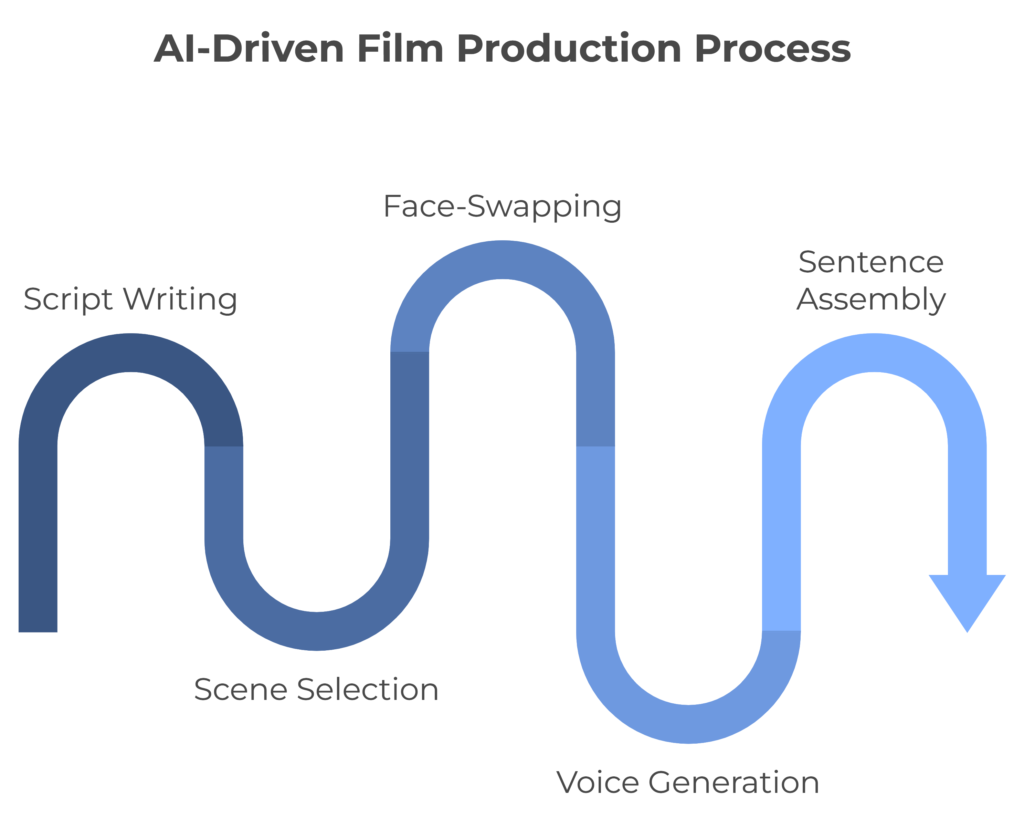
“What I was trying to do is attempt to automate each part of the human creative process,” Sharp says, “to see if we learn anything about what it is to be a human person creating films.” (Wired, 2018)
Will AI Replace Filmmakers?
Let’s look at what the industry leaders think about whether AI applications can pose a threat to human creativity.
A statement from Netflix CEO Ted Sarandos sheds light on this,
1. “I think that the creators who learn to use these tools better than everyone else are gonna win…not companies who create, but people who create,” (Literally! Podcast, 2024)
He continues that while AI can replicate or imitate certain features, there is something unique and authentic about the human experience, and people know when it’s being faked.
Celebrated filmmaker James Cameron, who directed the films Titanic and Avatar, is also skeptical about AI’s capabilities to document the human experience.
2. “I just don’t personally believe that a disembodied mind that’s just regurgitating what other embodied minds have said — about the life that they’ve had, about love, about lying, about fear, about mortality — I don’t believe that’s something that’s going to move an audience,” said Cameron. (CTV News, 2023)
Ridley Scott, known for directing films in the science fiction, crime, and historical drama genres such as The Martian (2015), has a much more cynical view of AI.
3. He calls artificial intelligence a “technical hydrogen bomb” that humans do not know how to lock down. (Rolling Stone, 2023)
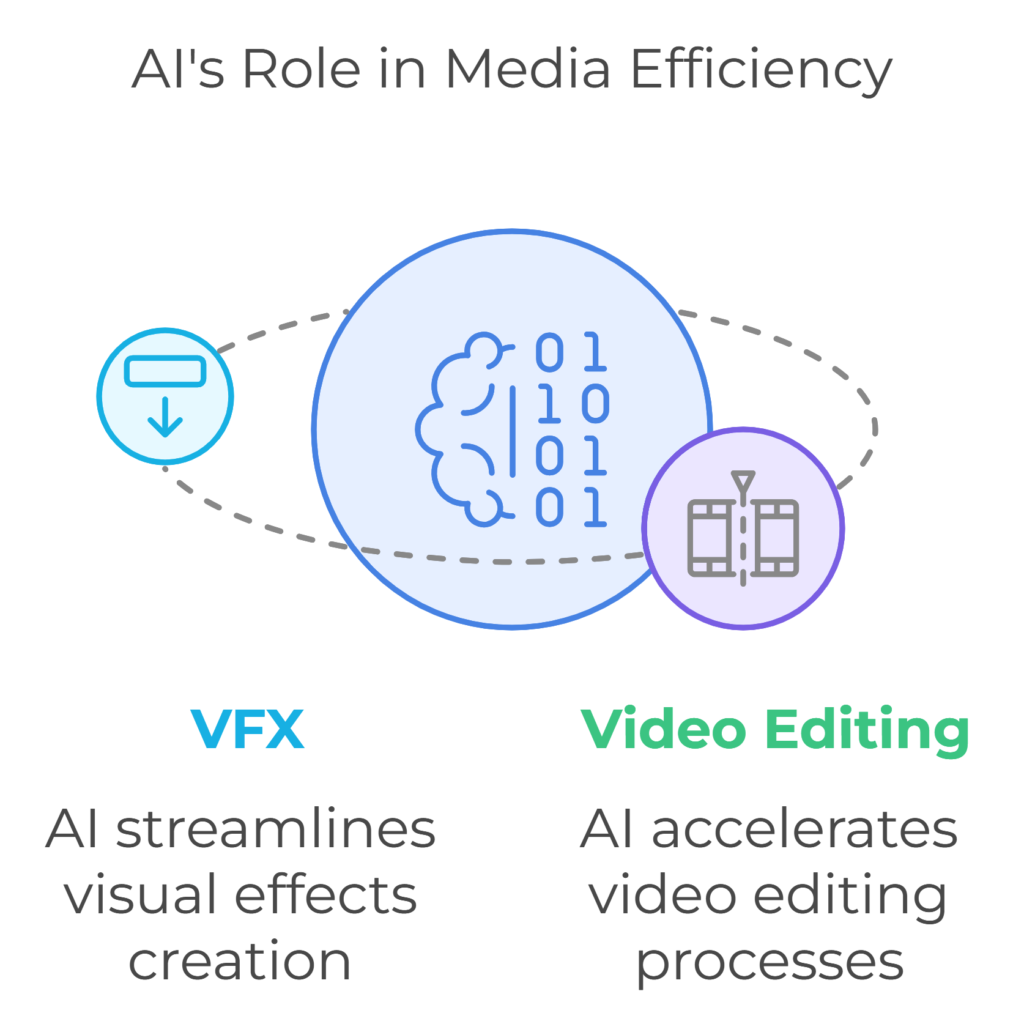
4. Yet many industry leaders admit that AI is efficient at saving time, especially for tasks like VFX and video editing. (MIT Sloan Review, 2023)
How Can AI Be Used in the Media and Entertainment Industry?
In the process of movie making, AI can be incorporated to write creative scripts, enhance visuals, and create a more immersive experience.
1. The advantages of AI are high efficiency and counter-intuitively more creative scripts, while the disadvantage is a lack of human emotionality. (Research Gate, 2024)
AI is also a boon for creators who want to make visuals enthralling.
2. AI systems provide a lot of opportunities for crafting visually stunning and immersive films that exceed conventional imagination. (Dimension Market Research, 2024)
3. Current paths in generative models, like neural networks and deep learning, empower filmmakers to create lifelike CGI characters and immersive settings. (Dimension Market Research, 2024)
Let’s look at how AI can benefit each of the various stages of the filmmaking process in depth.
AI in Film Production
The readiness of creators in the film industry to adopt AI and share the ideation step of filmmaking is still quite meager.
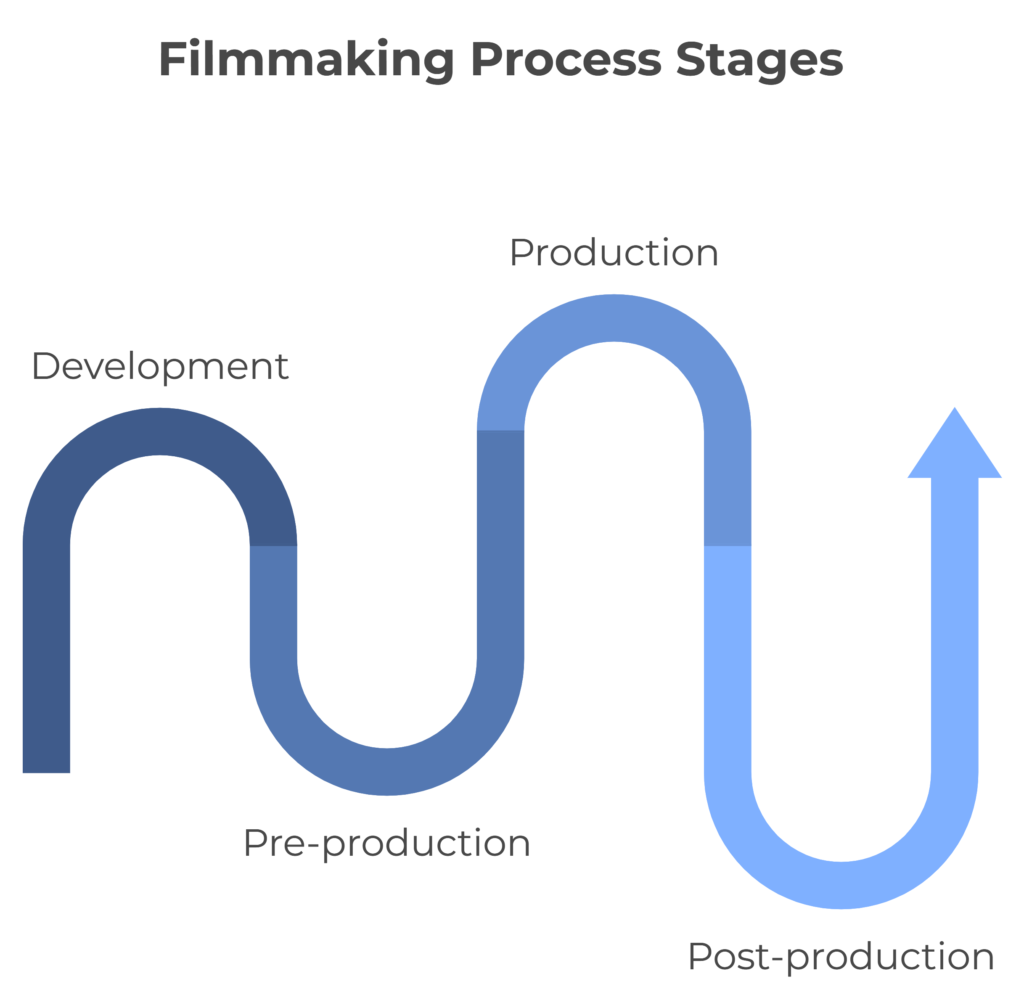
1. AI-powered tools streamline the post-production process. (Dimension Market Research, 2024)
Yet, AI is not a one-shot solution for film production.
2. The major issue with AI technologies available nowadays for post-production is that it cannot be utterly relied on. (Theseus, 2022)
3. The necessity for supervision by a human professional may be as little as only a final check, or as big as monitoring throughout the task with required manipulations. (Theseus, 2022)
Five industry professionals in the film industry were asked about their views:
4. All five respondents share an opinion, that in the next 10 years, AI will not be able to overcome the creative skills of professionals. (Theseus, 2022)
5. According to them, the authentic movies and videos, that impress the public beyond explicable will be entirely human domain still. (Theseus, 2022)
AI in Animation
AI is transforming the animation industry by speeding up tasks like frame generation and character rigging.
1. AI is revolutionizing the animation industry, accelerating processes such as intermediate frame generation and streamlining character rigging. (Myth Studio, 2024)
2. Software like Autodesk Maya, Adobe Character Animator, or Adobe Animate CC help animators save time and effort during production. (Myth Studio, 2024)
3. Although great for automation, AI cannot provide the same level of creativity and storytelling as human animators. (Myth Studio, 2024)
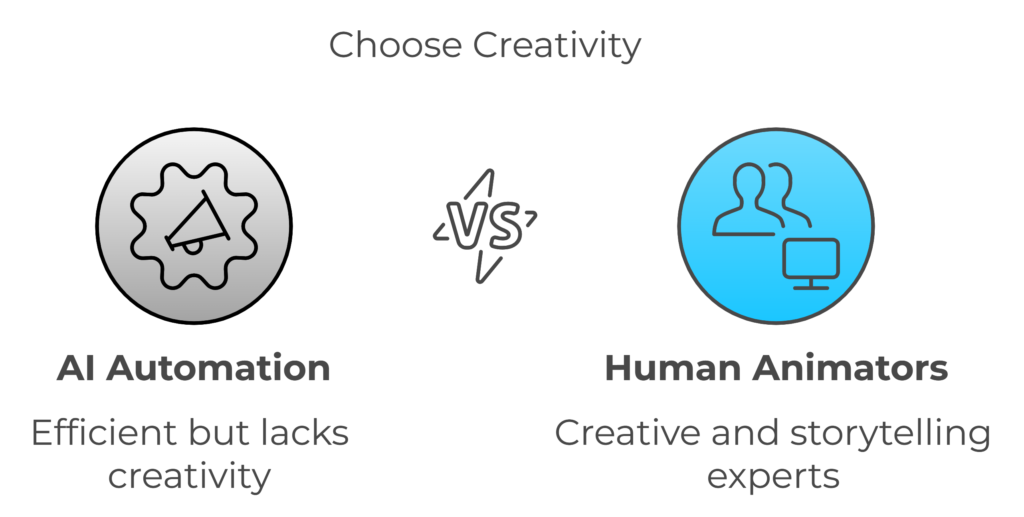
Although, it can enhance creators’ artistic freedom in previously unseen ways.
5. With examples like RADiCAL, Animate Anything, Cascadeur, DeepMotion, and Monstermash. zone, animation professionals can explore their craft in ways that weren’t possible before. (Myth Studio, 2024)
AI in Scriptwriting
AI content is allowed in scriptwriting by the Writers Guild of America.
1. The Writers Guild of America has said they would allow artificial intelligence in scriptwriting, as long as writers maintain credit. (Variety, 2023)
2. When several prompts for ChatGPT to write a movie script were tried out, apart from a few glaring flaws, the results didn’t suffer too much in quality either. (Variety, 2023)
Belgium-based company Scriptbook has launched its own AI scriptwriting bot called Deepstory.
3. It has more than 150000 users and has generated more than 15000 scripts. (DeepStory, 2024)
4. The creators of the DeepStory script generator don’t claim any copyright on the scripts DeepStory writes, although the government rules are still unclear. (DeepStory, 2024)
AI in Visual Effects
With the help of neural networks and generative algorithms, CGI and VFX become less challenging to implement.
1. AI can be used as a VFX co-pilot and first-pass editor. (Doug Shapiro, 2023)
2. AI rotoscoping from Runway was used on the 2022 film Everything Everywhere All at Once, which won multiple Academy Awards including Best Picture. The VFX team used it on one climactic scene. (Variety, 2023)
When speaking of AI being used in VFX, the CEO of the AI tool Runway, says:
3. “It’s transformative because it frees up your time and costs to focus on the creative iterations and ideas. It translates days of work into minutes,” says Runway CEO Cris Valenzuela. (Variety, 2023)
Runway was a co-creator of Stable Diffusion, the most popular AI image generator.
Virtual Reality and Augmented Reality
VR aims to seamlessly integrate the user into the virtual environment, with the help of hardware tools such as headsets.
Leading tech companies are investing in VR/AR.
1. Google, Meta, Microsoft, Nvidia, and other major companies are all driving research in augmented reality, mixed reality, and virtual reality to increase audience engagement. (IEEE, 2022)
One major use case is computer vision.
2. Using AI, camera inputs can provide motion tracking data which allows the virtual reality or augmented reality experience to seamlessly blend with the user’s perspective. (IEEE, 2022)
3. One emerging area of AI research is the creation of 3D scenes from single photographs. This technology is still in its infancy, but it could dramatically reduce the cost of creating an immersive experience. (IEEE, 2022)
22% of People Believe Gen AI Can Write TV Shows And Movies More Interesting Than Humans
The perspective that Gen AI could write more interesting tv shows is most prevalent among Genz and millennials, according to Variety.
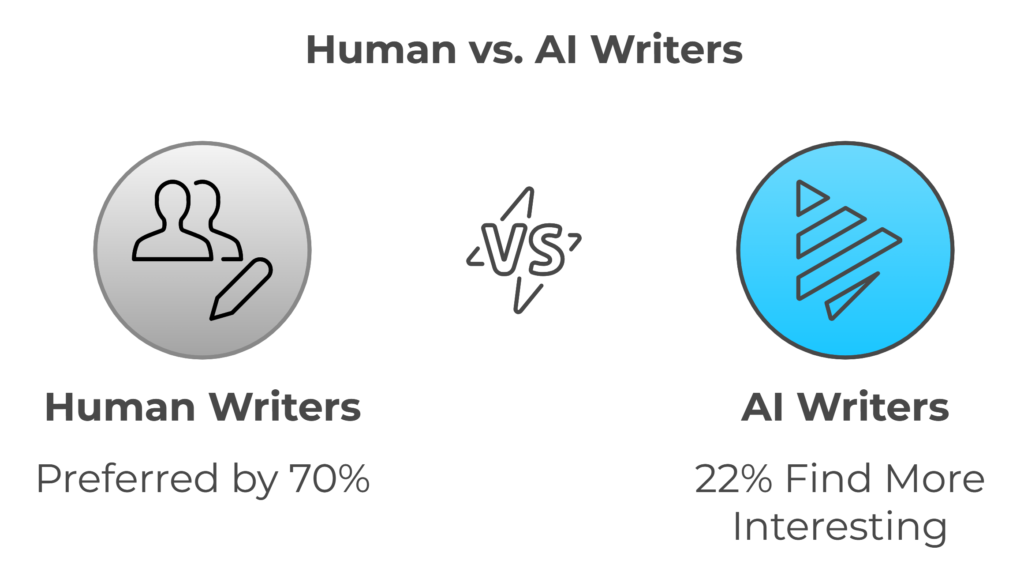
1. 70% of U.S. consumers say they would rather watch a TV show or movie written by a human instead of written by AI. (Variety, 2024)
2. Yet, 22% believed gen AI could write TV shows and movies that are more interesting than humans! (Variety, 2024)
Concerns With Artificial Intelligence
AI tools are being explored for scriptwriting, leading to concerns about job security as well as originality in the script.
While some industry leaders worry about AI, others view it as being limited in its ability to replace human creativity.
1. Widely available AI tools let readers gauge for themselves how easily ChatGPT can write a basic script when given a few prompts. (Wall Street Journal, 2023)
Actors are concerned about AI replacing them too.
2. Actors went on strike for 118 days in 2023 for fair compensation, residual increases, and protections around artificial intelligence. (Rolling Stone, 22024)
Jonathan Taplin, director emeritus at the Annenberg Innovation Lab at USC, has this to say:
3. “The way they train their models is by ingesting everything on the internet, with no concern for copyright,” Taplin told MIT Sloan Review.
Taplin’s main concern is that AI systems will replace human writers, artists, photographers, and other creatives working in the entertainment industry.
4. He also believes that it will exacerbate existing problems, such as movies relying on too many formulas for success, instead of novel ideas. (MIT Sloan Review, 2023)
5. Some experts like Yves Bergquist, Director of the AI & Neuroscience in Media Project at USC’s Entertainment Technology Center, have more favorable reviews. (MIT Sloan Review, 2023)
6. He calls generative AI a completely revolutionary technology characterized by misinformation and “some insanity.” (MIT Sloan Review, 2023)
As for his views on using Language Models like ChatGPT for scriptwriting, he quotes:
7. “It’s good at brainstorming ideas, but it will output only average content,” (MIT Sloan Review, 2023)
Stats Around Usage of AI in Predicting Film Success
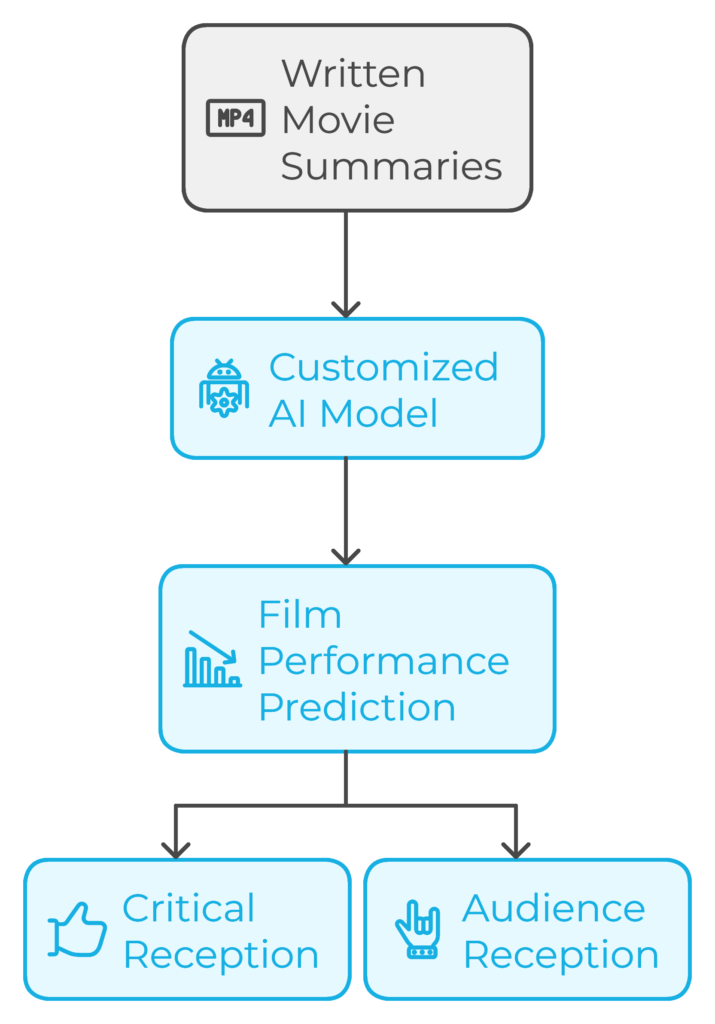
AI models can also be used to predict whether a film will do well at the Box Office.
Using only written movie summaries, many taken from Wikipedia, a customized AI model could consistently tell which films fare well with critics as well as audience members. (Science, 2019)
Final Thoughts
In conclusion, there is an undeniable impact of artificial intelligence on the movie industry, such as reducing production costs and saving hours of labor.
What remains to be seen is whether AI is used only to automate time-consuming tasks, enhance human creativity, or independently produce creative visual stories.
As forecasted by Gartner, by 2030 a major blockbuster film will be released with 90% of the film generated by AI. (Gartner, 2023)
AI systems could also hopefully lower the entry barrier required to make high-quality films by newcomers in the industry.

About the author
Editorial Staff
The Editorial Staff at Bot Memo is a team of writers, analysts, and AI agents dedicated to mapping the global AI startup ecosystem. Led by Chintan Zalani, the team tracks thousands of funding rounds, classifies companies across verticals, and distills it all into actionable intelligence for investors and founders.